
Heat Pump Installation Cost in Carlsbad: 2026 Pricing After Rebates
If you live in Carlsbad, the main thing to know is this: your final heat pump bill depends less on the unit alone and more on ductwork, electrical capacity, permits, and rebates.
I’d boil the article down to four points:
- Most single-family installs in Carlsbad fall into a broad range before incentives, then drop after rebates and tax credits if you qualify.
- Ducted systems and ductless mini-splits land in different ranges, with home size, number of zones, and access driving the total.
- The biggest add-ons are often duct sealing or replacement, panel upgrades, coastal corrosion protection, permits, and HERS testing.
- Your net out-of-pocket amount can change by thousands if you qualify for the federal tax credit, SDG&E rebates, or income-based help.
If I were budgeting this project, I’d focus on these questions first:
- Do you already have ducts, and are they in good shape?
- Does your electrical panel have room for a 30–50 amp circuit?
- Is your home within 5 miles of the ocean and likely to need corrosion protection?
- Does the equipment meet AHRI and efficiency rules for rebates?
- Are the quote totals showing permits and HERS testing in writing?
Here’s the short version: Carlsbad installs often run above U.S. averages because of California code rules, local labor, and coastal conditions. And square footage alone is not enough to size a system. I’d want a Manual J load calculation, then I’d compare quotes line by line so I could see what’s equipment, what’s labor, and what’s extra site work.
| What to check | Why it matters |
|---|---|
| System type | Ducted and ductless setups have different install paths |
| Home size and layout | Affects capacity, labor time, and zone count |
| Duct condition | Leaky ducts can trigger sealing or replacement |
| Electrical panel | Older panels may need an upgrade |
| Incentive eligibility | Can cut the final amount by 30% up to $2,000 federally, plus local utility help |
Bottom line: I’d treat any online estimate as a starting point only. For a Carlsbad home, the number that matters is the one based on a site visit, a load calculation, and confirmed rebates.
How Much Does a Heat Pump Cost? Between $8K and $23K - Here's Why
sbb-itb-a7630c3
2026 heat pump installation costs in Carlsbad by system type and home size
Heat Pump Installation Cost in Carlsbad 2026: By System Type After Rebates
Use these ranges as a starting point, then adjust for rebates and any job-site work.
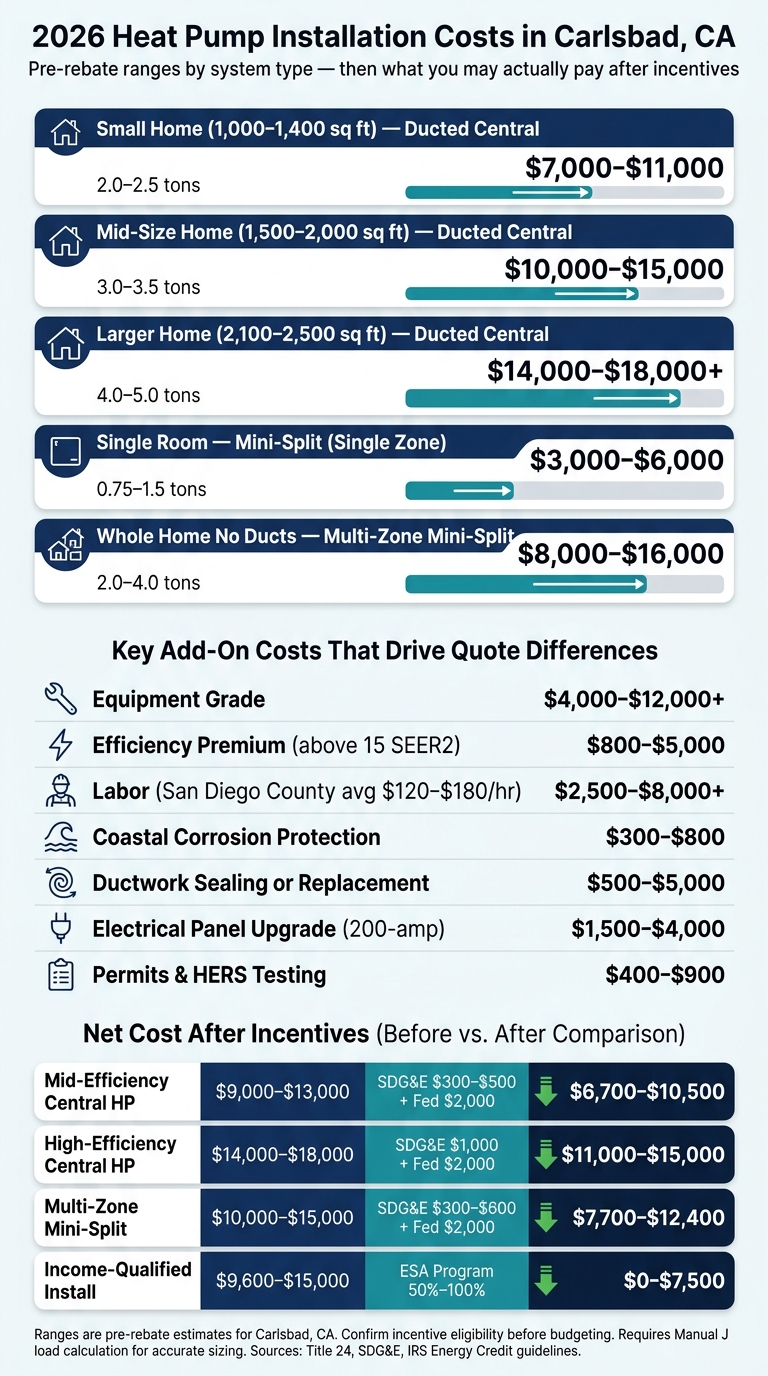
| Home Size (Sq. Ft.) | System Type | Typical Capacity | Pre-Rebate Installed Cost | Typical Price Drivers |
|---|---|---|---|---|
| 1,000 – 1,400 | Ducted Central | 2.0 – 2.5 tons | $7,000 – $11,000 | Corrosion-resistant coating, smart thermostat |
| 1,500 – 2,000 | Ducted Central | 3.0 – 3.5 tons | $10,000 – $15,000 | Duct sealing, electrical circuit upgrade |
| 2,100 – 2,500 | Ducted Central | 4.0 – 5.0 tons | $14,000 – $18,000+ | Full duct replacement, 200-amp panel upgrade |
| 1 room / zone | Single-Zone Mini-Split | 0.75 – 1.5 tons | $3,000 – $6,000 | Electrical sub-panel, line set cover |
| Whole home (no ducts) | Ductless Multi-Zone | 2.0 – 4.0 tons | $8,000 – $16,000 | Multiple indoor heads, complex line set routing |
Ducted central heat pump costs for small, mid-size, and larger homes
For smaller ducted homes, the math is usually pretty simple. Most jobs need standard equipment plus a bit of protection from salty coastal air. A corrosion-resistant coating on the outdoor unit usually adds $300 to $800, and a smart thermostat is often included to meet Title 24 control rules at $150 to $250.
Mid-size homes tend to get more expensive because of the ductwork. California Title 24 requires HERS testing for duct leakage and airflow, which adds $150 to $300. If the ducts leak more than 15%, sealing or replacement is required and can add $800 to $5,000 to the total. At this home size, an electrical circuit upgrade is also common.
Larger homes usually bring the biggest add-ons. Full duct replacement for a 2,000 sq. ft. home can run $2,000 to $5,000, and a 200-amp panel upgrade typically costs $1,500 to $4,000.
Ductless mini-split costs for single-zone and multi-zone installs
For a single-zone install, the biggest variables are line-set length and how hard it is to route refrigerant lines through walls or ceilings.
For multi-zone systems, the price tends to climb with each indoor head. Longer refrigerant runs, added electrical work, and tougher routing are usually the main reasons.
How higher efficiency equipment affects the upfront price
California requires a minimum of 15 SEER2 for new installs, and that has already pushed baseline equipment costs up by $500 to $1,500 compared with older standards. That means even a basic new system starts higher than many homeowners expect.
A 16 SEER2 unit can cost about $800 more than a 14 SEER2 unit, but it may cut SDG&E bills by $200 to $400 per year. Move up to 20+ SEER2, and the jump gets bigger. These units often use inverter-driven compressors and premium controls, which can add $2,000 to $5,000+ to the base install cost.
In Carlsbad, coastal conditions matter too. Corrosion-resistant coils and galvanized steel cabinets can add $300 to $800 to the equipment cost.
The next section explains which parts of a quote usually move the price most.
What drives price differences between heat pump quotes in Carlsbad
Two quotes for the same home can be thousands of dollars apart. That sounds wild at first, but it usually comes down to a few line items. Once you know what those line items mean, it gets much easier to compare quotes apples to apples.
| Cost Category | Typical Carlsbad Range | When It Applies |
|---|---|---|
| Equipment Grade | $4,000 – $12,000+ | Higher for variable-speed/inverter vs. single-stage units |
| Efficiency Premium | $800 – $5,000 | For units exceeding the 15 SEER2 minimum |
| Labor | $2,500 – $8,000+ | Increases with attic access difficulty, line set length, or multi-day installs |
| Corrosion Protection | $300 – $800 | Especially for homes within 5 miles of the ocean |
| Ductwork Work | $500 – $5,000 | Sealing starts around $500; full replacement starts around $2,000 |
| Electrical Upgrades | $1,500 – $4,000 | Required when the existing panel can't support a 30–50 amp circuit |
| Permits & HERS Testing | $400 – $900 | Mandatory for all legal replacements in Carlsbad |
Equipment grade, efficiency level, and labor
One of the biggest swings in price usually starts with the equipment. A basic single-stage unit may be enough for some homes. But a variable-speed inverter system can adjust output all the time, which usually means better comfort and lower energy use.
The table above lays out the main drivers. From there, the key is to separate the equipment cost from site-specific add-ons.
Labor is a big part of the gap too. San Diego County labor rates average $120 to $180 per hour - about 25% above the national average. That shows up in every quote before you even get to extra work. If the crew has to squeeze through a tight attic, run long refrigerant lines, or deal with a tricky drain setup, labor hours can stack up fast. A simple swap-out in a single-story home with easy access will usually cost less than installing that same system in a two-story home with a cramped attic.
Ductwork, electrical upgrades, permits, and testing
A lot of local installs hit at least one hidden cost: old ducts, an undersized electrical panel, or both.
California Title 24 requires duct leakage testing on permitted installs. If leakage is over 15%, the contractor has to seal or replace the ducts before the job can pass inspection. Sealing usually runs $500 to $2,000. Full replacement can start around $2,000 and go much higher depending on the home.
Electrical work can push quotes up fast too. If your home has an older panel that can't support the needed 30–50 amp circuit, a 200-amp panel upgrade adds $1,500 to $4,000 on top of the rest of the job.
Permits and HERS testing usually add $400 to $900 in Carlsbad. If a quote leaves those out, it's not complete. Make sure both items appear in writing. These are the gross-cost drivers; rebates and tax credits affect your net price.
Rebates, tax credits, and local incentives available in 2026
Those gross prices are just the starting point. In Carlsbad, rebates and tax credits can cut thousands off a 2026 heat pump install. The catch? Program rules shift fast, and funding can dry up without much warning.
Federal, California, and utility savings programs to check
Start by checking which programs can trim your out-of-pocket cost in Carlsbad.
The federal Energy Efficient Home Improvement Credit is worth confirming before you build it into your budget. When available, qualifying heat pumps have historically qualified for a 30% tax credit, capped at $2,000 per year.
San Diego Gas & Electric (SDG&E) offers rebates from $300 to $1,000 for qualifying high-efficiency heat pumps, based on the system’s efficiency. Funds are limited, so it’s smart to check availability before you sign anything.
For income-qualified households, the Energy Savings Assistance Program in San Diego County may cover 50% to 100% of replacement costs after a home energy audit. Some state rebate funds, including TECH Clean California in SDG&E territory, have limited availability and may not be taking new applications.
Energy Upgrade California also offers up to 10 years of zero-interest financing for qualifying projects.
How to calculate your net cost after combining eligible savings
A simple way to estimate your total is to subtract point-of-sale rebates first, then utility rebates, and then any federal tax credit when you file.
That said, stacking rules can get tricky. Not every program works with every other one. Some income-qualified grants may block you from combining other savings, so check the fine print before you assume everything can be used together.
Most programs also require AHRI-matched equipment that meets the right efficiency standards. Hold on to your AHRI paperwork, model numbers, and permit records. You’ll likely need them for rebate forms and later tax filing.
Use the examples below to estimate your project total.
| System Type | Pre-Incentive Cost | Potential SDG&E/Local Rebate | Potential Federal Tax Credit (if eligible) | Approx. Net Cost Range |
|---|---|---|---|---|
| Mid-Efficiency Central HP | $9,000 – $13,000 | $300 – $500 | Up to $2,000 | $6,700 – $10,500 |
| High-Efficiency Central HP | $14,000 – $18,000 | $1,000 | Up to $2,000 | $11,000 – $15,000 |
| Multi-Zone Mini-Split | $10,000 – $15,000 | $300 – $600 | Up to $2,000 | $7,700 – $12,400 |
| Income-Qualified Install | $9,600 – $15,000 | 50% – 100% (ESA Program) | N/A | $0 – $7,500 |
These examples assume you qualify for the listed incentives.
If your project qualifies, zero-interest financing can help cover the upfront gap until tax time.
How to budget your heat pump project and get a local estimate
Use the net-cost ranges above to turn a rough estimate into a budget that fits your home. Before you ask for bids, set a budget range that makes sense for your setup.
A 5-step cost worksheet for homeowners
Work through these five steps in order before talking to a contractor.
- Pick your system type. Review the pricing section above and match your home to the right system category. The big factors are whether you already have ducts and how many parts of the home need heating and cooling.
- Add likely ductwork costs. If your ducts are old, leaky, or too small, budget for sealing or replacement so the system can meet Title 24 requirements.
- Check your electrical panel. Heat pumps need enough electrical capacity. If your current panel is under 200 amps, plan for an upgrade.
- Include permits, testing, and coastal protection. Add permits, HERS testing, and - if your home is within 5 miles of the ocean - corrosion-resistant coatings on the outdoor unit.
- Subtract eligible incentives. Only subtract incentives you’ve confirmed you can get.
Square footage by itself does not size a heat pump the right way. Use a Manual J load calculation. That gives you a clearer scope, and it helps make sure each quote is based on the same assumptions during the site visit.
Conclusion: The key numbers and decisions to focus on
Your gross project cost - before any incentives - is the first number to pin down. After that, layer in only the rebates and credits you’ve confirmed. The quickest way to get to a realistic budget is a site-specific estimate that accounts for ducts, electrical capacity, and eligible savings.
FAQs
How much should I budget before rebates?
In Carlsbad, plan on $7,000 to $18,000 for a central air-source heat pump before incentives.
Ductless mini-splits usually cost $3,000 to $8,000 per zone. Geothermal systems often land in the $15,000 to $30,000+ range.
What you actually pay can swing based on a few big factors: equipment efficiency, your home's size, and whether the job needs electrical work or duct upgrades. In 2026, many major state and federal incentives are exhausted or waitlisted, and the federal 25C tax credit has expired.
Will my ducts or panel need upgrades?
It depends on your home’s current ductwork and electrical capacity.
Under California Title 24, ducts must be leakage-tested during installation. If leakage is over 15%, they must be sealed or replaced.
That can be a sticking point in older homes. Homes built before 1980 often have undersized ducts or electrical panels that can’t support a full-electric heat pump without extra work.
In many cases, that means paying for upgrades before the system can go in:
- Electrical upgrades typically cost $1,500–$4,000
- Duct repairs or replacement can add $1,000–$8,000+
So the heat pump itself may be only part of the job. The condition of your ducts and panel can shape how much work the install takes.
Which rebates can I combine in Carlsbad?
In Carlsbad, homeowners can often stack a few programs to cut heat pump installation costs, including:
- a federal tax credit of up to $2,000
- SDG&E rebates from $300 to $1,000
- state or local energy programs
For low-income households, there may be even more help available. The Energy Savings Assistance Program can cover 50% to 100% of replacement costs.