
Heat Pump or Central AC: How to Choose for a Carlsbad Home
If you’re deciding between a heat pump and central AC for your Carlsbad home, here’s the key takeaway:
- Heat pumps provide both heating and cooling in one system, making them ideal for Carlsbad’s mild winters and warm summers. They’re energy-efficient and align with California’s push toward electrification, but they require more frequent maintenance in coastal environments.
- Central AC systems focus solely on cooling and pair with a furnace for heating. They’re a good option if your furnace is in good shape, but they rely on gas for heating, which adds to energy costs and emissions.
For homes near the coast, corrosion-resistant equipment and regular servicing are crucial due to salt air. If you’re upgrading, consider system compatibility with the new R-454B refrigerant standard in 2026.
Quick Comparison:
| Factor | Heat Pump | Central AC + Furnace |
|---|---|---|
| Functionality | Heating + Cooling | Cooling only (needs furnace) |
| Energy Source | All-electric | Electric (cooling) + Gas (heating) |
| Efficiency | High (saves ~75% on heating costs) | Lower for heating |
| Installation Cost | Higher upfront | Lower upfront (if furnace exists) |
| Lifespan | 10–12 years | 10–15 years |
| Environmental Impact | No direct emissions | Gas heating produces emissions |
Heat pumps are a long-term energy-saving solution, while central AC may be more practical if your heating system is still in good condition. Regular maintenance is critical for both systems in Carlsbad’s coastal climate.
Heat Pump vs. Central AC: Full Cost & Performance Comparison for Carlsbad Homes
AC vs. Heat Pump: Which is Better for Your Home? | Comprehensive Comparison
sbb-itb-a7630c3
Carlsbad's Climate and What It Means for Your HVAC System
Carlsbad's coastal location plays a big role in how your HVAC system performs. If you're deciding between a heat pump and a central AC unit, it's important to consider the unique challenges your system will face in this environment. Let’s break down the factors that influence HVAC performance in Carlsbad.
Temperature and Humidity Patterns in Carlsbad
Carlsbad enjoys mild weather, but that doesn’t mean your HVAC system gets to relax. The marine layer, a coastal fog that drifts in from the Pacific, creates consistent humidity cycles from late spring through early fall. According to Coastal Comfort San Diego:
"Salt air corrodes outdoor condenser coils faster than inland air. Marine layer humidity puts steady load on cooling equipment from late spring through early fall."
Add to that Carlsbad’s daily temperature swings - cool mornings followed by warmer afternoons - and your HVAC system needs to adapt quickly. Heat pumps are a great fit for this climate because they smoothly handle these shifts, providing both light heating and cooling without requiring separate systems.
Home Features That Affect HVAC Choices
The age and design of your home are just as important as the climate when it comes to choosing an HVAC system. For example, homes in Carlsbad Village, many of which were built in the 1980s, often have aging ductwork and single-pane windows. These can significantly reduce efficiency - duct leakage alone can cause up to a 30% efficiency loss, and older windows can lead to a similar percentage of heat loss.
In contrast, newer neighborhoods like Bressi Ranch and La Costa typically feature updated ductwork designed to handle the higher airflow demands of heat pumps during heating mode.
For homes near the ocean, corrosion resistance is key. Standard HVAC units with copper tubes and aluminum fins are prone to galvanic corrosion in salty air. Coastal-specific models solve this problem by using all-aluminum coils, zinc cladding, and protective coatings. These features make a big difference in extending the life of your system.
When You Need Both Heating and Cooling
Seasonal changes in Carlsbad mean your HVAC needs can shift throughout the year. For most homeowners, a heat pump offers the best solution. It handles both heating and cooling in a single system, and Carlsbad’s mild winters, which generally stay above 35–40°F, allow heat pumps to operate efficiently without requiring a separate furnace. This makes them an ideal choice for balancing comfort and practicality in this region.
Heat Pump Systems: What Carlsbad Homeowners Should Know
How Heat Pumps Work in a Coastal Climate
A heat pump doesn’t generate heat - it transfers it. During the summer, it removes warm air from your home, while in winter, it pulls heat from outside air into your home. This dual functionality makes it a replacement for both a furnace and a central air conditioner.
Carlsbad’s mild winters are ideal for heat pump operation. As Dan West of Tytum puts it:
"If you live in a mild climate, the operating costs of a heat pump will be lower. You will save on energy bills over time, making a heat pump a more reasonable choice."
Since heat pumps provide cooling in summer and heating in winter, they’re well-suited to Carlsbad’s warm afternoons and cool coastal mornings. However, with the refrigerant shift from R-410A to R-454B set to take place by 2026, it’s worth discussing compatible models with your installer.
Next, let’s explore the costs, lifespan, and maintenance requirements to help you decide if a heat pump is the right choice.
Heat Pump Costs, Lifespan, and Maintenance
Carlsbad’s coastal environment, particularly the presence of salt air, makes regular maintenance a must. Installation costs for heat pumps typically range from $6,000 to $25,000, depending on factors like home size, system efficiency, and the condition of your ductwork. Most installations are completed within one to two days. Homeowners can also take advantage of California rebates and federal tax credits, such as those under the High Efficiency Electric Homes Rebate Act (HEERHA), to offset upfront costs.
On average, heat pumps last 10 to 15 years, with energy savings often covering the initial investment within 5 to 10 years. However, Carlsbad’s salty air can accelerate corrosion on outdoor components, making annual professional servicing especially important. Since the system operates year-round, it endures more wear than seasonal heating or cooling systems.
Curtis Herchenbach, owner of Herchenbach Mechanical, highlights an often-overlooked expense:
"Running new wire to the outdoor unit influences cost. With communicating systems... setting up and connecting the equipment and updating the controls is necessary, too."
Additionally, it’s crucial to have a technician inspect your ductwork and ensure the system is properly sized for your home, as these factors significantly affect efficiency.
Heat Pump Pros and Cons
Here’s a quick breakdown of the benefits and challenges of heat pumps based on their performance and maintenance needs:
| Advantages | Drawbacks | |
|---|---|---|
| Operation | Handles both heating and cooling with a single system | Higher initial cost compared to central AC alone |
| Efficiency | Up to 3x more efficient than gas furnaces in mild climates | May struggle during rare extreme cold spells |
| Environmental | Fully electric, aligning with California’s clean energy goals | Could require an electrical panel upgrade |
| Maintenance | One system to maintain instead of two | Year-round use increases servicing needs, and salt air speeds up wear |
Central AC Systems: What Carlsbad Homeowners Should Know
How Central AC Performs in Carlsbad
Carlsbad's mix of coastal and inland climates creates unique cooling demands. Central AC is particularly effective at maintaining comfort in these conditions. For inland neighborhoods like La Costa and Bressi Ranch, where summer temperatures often climb above 90°F, a well-sized central AC unit can handle the heat while also managing the marine layer's persistent humidity from late spring to early fall.
"The same coastal air that makes Carlsbad so pleasant also carries salt and moisture that can corrode outdoor AC condensers... faster than in inland areas." - Coastal Comfort San Diego
This coastal influence means outdoor units near the ocean face additional wear and tear. To combat this, homeowners should prioritize systems with corrosion-resistant finishes and schedule regular maintenance to extend the lifespan of their equipment.
Central AC Costs, Lifespan, and Maintenance
Installing central AC in the San Diego area typically costs between $3,000 and $10,000 or more, depending on factors like home size and the condition of existing ductwork. If your home already has a functioning furnace and well-maintained ductwork, adding central AC can be an economical cooling upgrade. For instance, newer neighborhoods like Bressi Ranch often feature modern duct systems designed for high-efficiency units, whereas older homes in Carlsbad Village may require ductwork updates before installation.
Central AC systems generally last 10 to 15 years, though coastal environments can shorten this lifespan without proper care. Regular maintenance - ideally every 6 to 12 months - is crucial in marine zones to counteract salt-related damage. Routine service typically includes tasks like cleaning filters and coils, as well as checking for refrigerant leaks.
"In marine areas, a 6 to 12 month service cadence for outdoor HVAC components is common." - Chris Martin, CA DRE# 01713335
Looking ahead, central AC units purchased in 2026 will use R-454B refrigerant instead of the older R-410A. If you're planning to replace your system soon, make sure the new model is compatible with this refrigerant.
Central AC Pros and Cons
| Advantages | Drawbacks | |
|---|---|---|
| Cost | Lower upfront cost when a furnace and ductwork are already in place | Requires a separate furnace for heating |
| Cooling | Effective during 90°F+ inland heat waves | Higher monthly energy use compared to heat pumps |
| Humidity | Reduces humidity effectively during "June Gloom" | Coastal moisture can cause mold if ventilation is poorly balanced |
| Maintenance | Common technology with readily available parts and technicians | Coastal units corrode faster, requiring frequent servicing |
| Compatibility | Ideal for newer homes with updated ductwork, like those in Bressi Ranch | Older homes in Carlsbad Village may need duct upgrades |
Heat Pump vs. Central AC: A Direct Comparison for Carlsbad Homes
Comfort and Day-to-Day Performance
Both heat pumps and central AC systems work by removing heat and humidity to cool your home. The main distinction comes into play during colder months: a heat pump serves as a dual-purpose system, offering both heating and cooling, while a central AC focuses solely on cooling and requires a furnace for heating. In Carlsbad, where winters are mild and temperatures rarely dip below 25–30°F, a heat pump can handle year-round climate control effectively. However, because heat pumps operate throughout the year, they may experience slightly more wear and have a shorter lifespan compared to a central AC system. Next, let’s explore how these operational differences impact energy consumption and monthly costs.
Energy Use and Monthly Operating Costs
When it comes to energy efficiency, it’s important to consider both cooling and heating performance. During cooling, a heat pump and a central AC unit with the same SEER2 rating use comparable amounts of energy. The difference becomes apparent during heating. Heat pumps transfer heat rather than generate it, making them significantly more efficient - using about 75% less electricity than electric resistance heating. To keep energy bills manageable, maintaining a thermostat setting around 78°F can help prevent overworking the system and unnecessary costs. Additionally, factoring in environmental impact and available rebates can provide a clearer picture of the overall cost-effectiveness.
Carbon Footprint and California's Energy Goals
Another critical factor to consider is the environmental impact of each system. Heat pumps run entirely on electricity, producing no direct carbon emissions and qualifying for higher rebates to offset installation costs. On the other hand, central AC units paired with gas furnaces rely on fossil fuels for heating, which results in ongoing carbon emissions. For homeowners in California, where decarbonization is a key goal, heat pumps align seamlessly with the state’s energy objectives. If you have solar panels, a heat pump offers an added advantage: you can power both heating and cooling with clean, self-generated electricity.
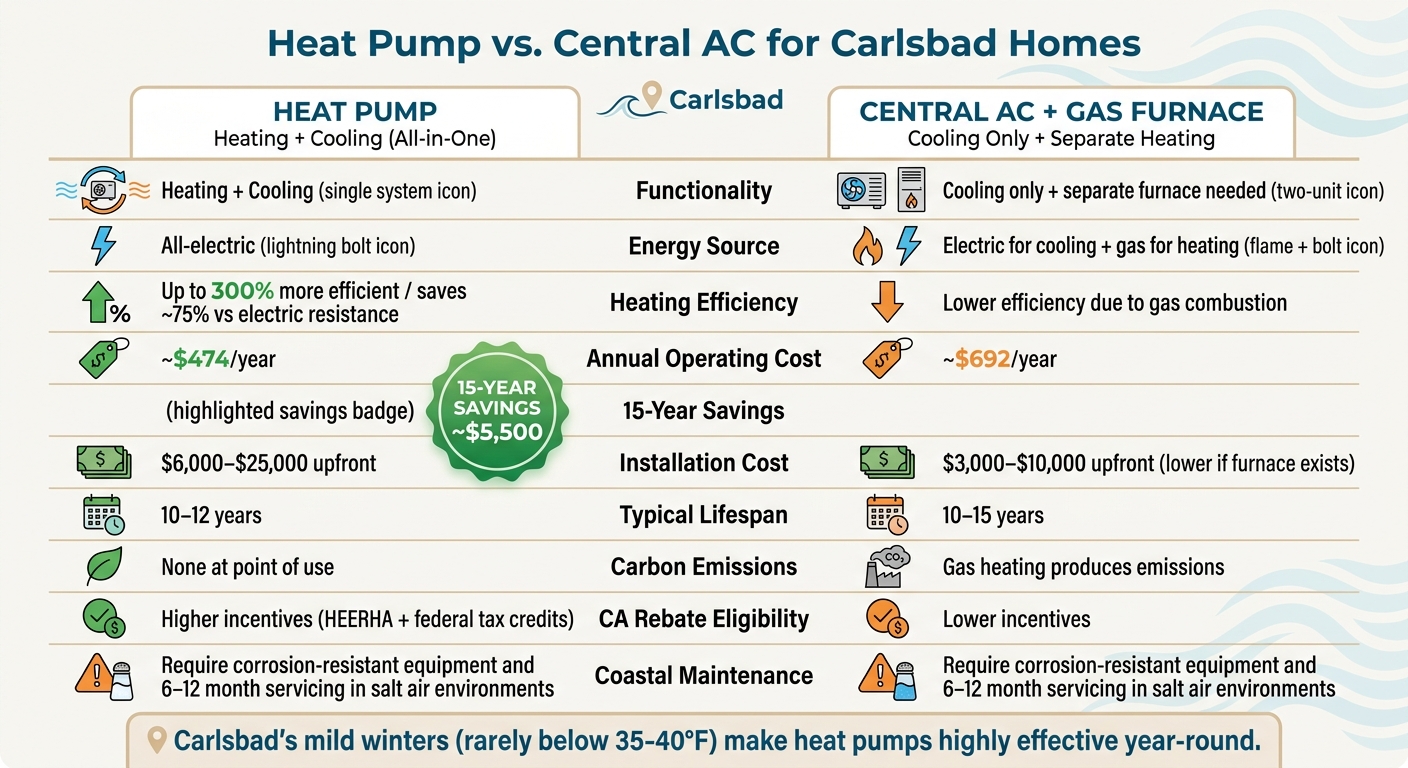
| Factor | Heat Pump | Central AC + Gas Furnace |
|---|---|---|
| Heating Function | Built-in | Separate furnace |
| Energy Source | All-electric | Electric (cooling) and gas (heating) |
| Heating Efficiency | Up to 300% more efficient | Lower efficiency due to combustion |
| Typical Lifespan | 10–12 years | 10–15 years |
| Carbon Emissions | None at point of use | Emissions from gas heating |
| CA Rebate Eligibility | Higher incentives available | Lower incentives available |
This breakdown sheds light on the differences in performance, energy efficiency, and environmental impact, helping you determine which system best suits your Carlsbad home.
How to Choose the Right System for Your Carlsbad Home
Key Factors to Consider Before You Decide
Choosing the best HVAC system for your Carlsbad home starts with evaluating your current setup, location, and energy priorities. Once you’ve reviewed system comparisons, these specific factors can help guide your decision.
Evaluate your existing heating system. If your gas furnace is in good shape, upgrading just the central AC might be the most economical choice. But if your furnace is old or relies on electric resistance heating, a heat pump could be a smarter option. Heat pumps can reduce electricity use by about 75% and provide both heating and cooling in one system.
Coastal homes face unique challenges. Being near the coast means dealing with accelerated wear due to salt air. This makes corrosion-resistant equipment and a tailored maintenance plan essential.
Consider solar compatibility. Heat pumps pair well with solar panels, allowing you to power heating and cooling with self-generated electricity. This is an advantage that traditional central AC and gas furnace systems don’t offer.
Explore available rebates. Federal and state incentives can help offset the higher upfront cost of a heat pump, making it a more affordable choice.
Steps to Assess Your Home's HVAC Needs
Once you’ve considered the main factors, follow these steps to better understand your home’s HVAC requirements.
- Schedule a Manual J load calculation. This professional assessment determines your home’s exact heating and cooling needs based on factors like square footage, insulation, and Carlsbad’s coastal climate. Without it, you risk installing a system that’s too large or too small, which can waste money and reduce efficiency.
- Inspect your ductwork. Older homes, especially those built in the 1980s, often have leaky or poorly sealed ducts. These issues can undermine the efficiency of even the most advanced HVAC systems.
- Check for salt air damage. If you live within a mile or two of the coast, inspect your outdoor unit for corrosion on the condenser coils. This can indicate the need for a coastal-rated unit or more frequent maintenance.
- Analyze your energy bills. Reviewing your gas and electricity costs over the past year can help you decide if the efficiency of a heat pump makes financial sense for your household.
- Ensure refrigerant compatibility. Starting in 2026, the HVAC industry will shift from R-410A to R-454B refrigerant. Choosing a system compatible with the newer refrigerant now can save you from future service headaches.
How Coastal Comfort San Diego Can Help

Coastal Comfort San Diego, a family-owned business based in Carlsbad, has over 30 years of experience serving homes across San Diego County. They provide personalized HVAC assessments that include Manual J load calculations and ductwork inspections, all without the pressure of commission-based sales. Their recommendations focus solely on your home’s actual requirements.
Their services cover everything Carlsbad homeowners typically need: heat pump installations, central AC replacements, duct sealing, and maintenance plans tailored for coastal conditions like salt air and high humidity. They also offer guidance on the upcoming refrigerant transition in 2026, ensuring your system remains efficient and serviceable for years to come.
With free estimates and flexible financing options, they make it easier to compare the costs of a heat pump versus a central AC system. This personalized support helps ensure your HVAC choice fits your home’s needs and the challenges of Carlsbad’s coastal environment.
Conclusion: Picking the Right HVAC System for Your Carlsbad Home
Deciding between a heat pump and central AC comes down to your home's current setup and your priorities. If your gas furnace is in good shape, adding central AC might be the easier route. On the other hand, if your heating system is nearing the end of its lifespan or you're aiming for lower energy bills, a heat pump can provide dual functionality and save you about $5,500 over 15 years.
Carlsbad's mild coastal climate also plays a role. Heat pumps perform well in such conditions, as extreme cold isn't a concern. However, the marine layer and salty air common in the area mean corrosion protection and consistent maintenance are essential.
While the upfront cost of a heat pump is higher, the lower yearly operating expense - around $474 per year compared to $692 for a central AC and furnace - makes it a cost-effective option in the long run. Federal tax credits and local rebates can help offset the initial investment even further.
"No salespeople, no upselling, no commissions - just honest information so you can make a good decision about your home." - Coastal Comfort San Diego
This straightforward approach reflects Coastal Comfort San Diego's dedication to helping homeowners choose the best system for their needs. By making the right choice now, you can enjoy reliable comfort and reduced energy costs for years to come.
With over 30 years of experience in the area, Coastal Comfort San Diego is well-versed in the challenges coastal homes face, from salt air corrosion to the upcoming 2026 refrigerant switch to R-454B. Their free estimates and 0% APR financing options make the decision process easier and more accessible.
FAQs
Do I need new ductwork for a heat pump?
If you're considering a heat pump, whether you need new ductwork largely depends on your home's existing system. Many homes in Carlsbad with newer ductwork might already be compatible. However, if your ductwork is older or has damage, it may need repairs, sealing, or even replacement to work efficiently with the heat pump. To ensure everything runs smoothly, it's best to have a professional assess your system and recommend any necessary updates.
Will I need an electrical panel upgrade for a heat pump?
If your existing electrical panel isn't equipped to handle the increased load of a heat pump, you might need an upgrade. This step is often crucial for safely supporting energy-efficient systems like heat pumps and ensuring they operate properly.
Should I wait for the 2026 R-454B refrigerant change?
You don’t have to hold off until 2026 for the R-454B refrigerant change. Most current HVAC systems are designed to work with the refrigerants already in use. However, if you're planning to upgrade or replace your equipment, it’s smart to think ahead. Choosing a system that’s compatible with future standards can save you from headaches later on and keep your setup running smoothly as regulations evolve.