

How to Read an HVAC Quote in Carlsbad (and Spot the Markup)
Understanding an HVAC quote can save you from unexpected costs and ensure you get the right system for your home. Here’s what to focus on:
- Key Elements: A detailed quote should include equipment specs (model numbers, SEER2 ratings), labor hours, permits, and warranties.
- Coastal Requirements: For homes near the ocean, ensure the quote specifies coastal-rated, epoxy-coated equipment to prevent corrosion.
- Labor Costs: Labor in Carlsbad typically ranges from $75 to $150 per hour. Verify the estimated hours and crew size.
- Hidden Fees: Watch for charges like ductwork upgrades, old equipment removal, or electrical panel updates. These should be itemized.
- Permits: Contractors must pull permits under their name to protect your warranty and liability.
- Rebates: Look for federal tax credits and local rebates that can reduce costs significantly.
Always cross-check equipment model numbers at ahridirectory.org, confirm a Manual J load calculation was performed, and compare multiple quotes to ensure transparency. A trustworthy contractor will provide clear, itemized pricing without hidden fees or vague descriptions.
Key Parts of an HVAC Quote
Standard Sections of a Quote
An HVAC quote typically breaks down into five main areas: equipment, labor, ancillary materials, permits/inspections, and warranty terms. It should clearly outline the full scope of work, including removals, installations, ductwork modifications, and system testing. Any exclusions must also be explicitly stated. A well-detailed quote helps avoid hidden fees and ensures transparency.
"A good HVAC quote is one page or ten - what matters is whether you can tell exactly what you're paying for." - ComparePros Editorial Team
Some quotes may also mention rebates like federal 25C tax credits, SDG&E instant rebates, or TECH Clean California incentives. When these are included, it's a sign that the contractor is being thorough and looking out for your best interests.
Equipment Details and Specifications
The equipment section is often the most expensive part of the quote, typically accounting for 45% to 60% of the total cost. It should include specific model numbers for key components like the outdoor condenser, indoor air handler or furnace, and evaporator coil. Vague descriptions like "3-ton unit" can lead to substitutions with lower-quality equipment. To verify the equipment's efficiency and compatibility, you can cross-check the model numbers at ahridirectory.org. Keep in mind, mismatched systems can lose up to 15% of their rated efficiency.
Pay attention to the SEER2 (cooling efficiency) and HSPF2 (heating efficiency for heat pumps) ratings. By 2026, the federal minimum for SEER2 is set at 14.3, so anything below that shouldn't be included in the quote.
For homes near the coast, like those within two miles of the ocean in Carlsbad, the quote should specify coastal-rated coils with epoxy or e-coat treatments. These upgrades, which cost an additional $400 to $600, are crucial since uncoated coils can fail 3 to 5 years earlier due to salt exposure.
Another key detail to look for is whether the quote references a Manual J load calculation. This industry-standard method ensures the system is sized correctly for your home's square footage, insulation, and window layout. Without this, the quoted system tonnage might not be accurate.
After reviewing the equipment section, move on to labor rates and permit details to assess the overall reliability of the quote.
Labor, Permits, and Additional Charges
Labor costs in Carlsbad range between $75 and $150 per hour. For a typical split-system replacement, labor takes 4–8 hours, while full system conversions can take between 1 and 3 days. The quote should detail the crew size and estimated hours, making it easier to evaluate labor charges.
Permits are a legal requirement for HVAC projects. In Carlsbad, a mechanical permit and final city inspection are mandatory for replacements. Permit fees usually range from $350 to $650. Importantly, the contractor should obtain the permit under their name. If they ask you to pull an "owner-builder" permit, this could shift liability to you, potentially voiding manufacturer warranties and causing issues with your homeowner's insurance.
Additional Charges
Some costs may not be immediately apparent in the quote, so it's essential to check for the following:
| Additional Charge | Typical Cost Range (Carlsbad) |
|---|---|
| Old equipment disposal/removal | $100 – $300 |
| Ancillary materials (pad, whip, lineset) | $300 – $900 |
| Ductwork modifications or sealing | $500 – $2,500 |
| New communicating thermostat | $75 – $300 |
| Electrical upgrades (panel/circuit) | $300 – $2,500 |
| Coastal coil coating (salt protection) | $400 – $600 |
If these items aren’t listed separately, they could be included in a lump sum or added unexpectedly later. A clear breakdown ensures you're aware of all potential costs upfront.
sbb-itb-a7630c3
What Drives HVAC Pricing in Carlsbad
Home Size, Layout, and System Access
When it comes to HVAC pricing in Carlsbad, several site-specific factors play a role. While square footage is a starting point, accurate pricing depends on Manual J load calculations. These calculations consider details like window orientation, insulation quality, and the local climate. Carlsbad’s coastal climate, for instance, often requires less cooling tonnage than inland areas. Typically, you’ll need about 400–600 square feet per ton of cooling capacity. For example, a 1,500-square-foot home would generally require a 3-ton system.
Labor and installation costs can rise if the system is difficult to access. Installing units in attics, on rooftops, or in multi-story homes can add $1,500 to $2,000 in labor expenses. Narrow side yards, which are common in Carlsbad’s tract homes, can also complicate condenser placement. Additionally, homes built before 1995 may need an electrical panel upgrade from 100A to 200A, which can cost between $2,500 and $5,000.
Another factor is ductwork. Leaky or aging ducts can reduce system efficiency by 20–30%. If more than 40% of the ductwork needs replacing, California’s Title 24 regulations require a third-party HERS rater to verify duct leakage. This inspection adds another $200–$400 to the cost. Understanding these variables can help you evaluate whether a quote reflects the unique challenges of your home’s layout and environment.
Coastal Climate and Equipment Durability
Carlsbad’s proximity to the coast introduces another layer of complexity. Salt air in the five-mile coastal zone accelerates corrosion on metal components. Without proper protection, a standard condenser might only last 7–10 years. Coastal-rated units, which are treated with epoxy or e-coat and built with corrosion-resistant materials, can last 15–20 years in the same environment.
"A standard-spec condenser installed near the Carlsbad coast might last seven to ten years before corrosion causes a failure. A coastal-rated unit... typically runs fifteen to twenty years." - Climate Pros SD
However, coastal-rated equipment comes with a higher upfront cost - typically 10% to 15% more. This means installation costs in Carlsbad are often $800 to $1,200 higher than in inland areas like Escondido.
Typical Cost Ranges for HVAC Systems
Here’s a breakdown of what you can expect to pay for installed HVAC systems in Carlsbad, assuming the use of coastal-rated equipment:
| System Type | Installed Price Range |
|---|---|
| Central AC - Single-stage, coastal-rated | $9,500 – $14,500 |
| Central AC - Variable-speed, coastal-rated | $12,500 – $18,000 |
| Heat Pump - Full replacement | $12,500 – $22,000 |
| Ductless Mini-Split - Single-zone, coastal-rated | $6,500 – $10,500 |
Variable-speed systems are particularly well-suited for Carlsbad’s mild climate. They operate at lower stages for longer periods, which helps remove humidity from the marine layer air more effectively. For heat pumps, 2026 rebates can significantly lower costs. These include a federal 25C tax credit of up to $2,000 and SDG&E TECH rebates ranging from $1,000 to $3,000. In some cases, these rebates can bring the net cost of a heat pump close to - or even below - that of a conventional AC system.
Lastly, keep in mind the transition to newer refrigerants like R-454B, which is set to take effect in 2025/2026. This shift adds $500–$1,500 to installation costs due to updated safety components and technician training requirements.
Real HVAC Price Quotes - A closer look at over 15 estimates and explanation of what affects cost
How to Spot Markups and Hidden Fees
Once you're familiar with the key components of an HVAC quote, the next step is to dig deeper and identify potential markups or hidden fees.
Checking Equipment Costs
Always request full model numbers for every piece of equipment listed on the quote. A vague description like "3-ton AC unit" doesn’t provide enough information. With the model numbers in hand, you can research distributor prices to spot markups that exceed 150%.
Typically, HVAC equipment comes with a markup ranging between 100% and 300% over the wholesale distributor price. While some markup is expected to cover operating costs - such as vehicles, insurance, and technician training, which can account for 25–40% of a contractor's revenue - markups beyond 150% are worth questioning.
"Anything above 150% of distributor cost is worth scrutinizing." - HVAC Project Cost Editorial Team
Watch out for phrases like "or equivalent", as they leave room for contractors to swap in lower-quality equipment after you’ve signed the contract.
Reading Labor Charges
Labor costs can reveal a lot about whether the quote is fair. For instance, a standard HVAC replacement in Carlsbad typically requires a two-person crew and takes between 6–12 hours. Simpler jobs, like replacing a split-system unit in a single-story home, might only take 4–8 hours. If you see a quote charging for 14 or more hours without additional work like duct repairs or electrical upgrades, it could mean the labor hours have been inflated.
In coastal areas, labor rates usually range from $75 to $150 per hour. This means the total labor cost for a standard replacement should fall between $2,500 and $5,000, depending on the complexity of the job. Another red flag is a quote that doesn’t separate labor and equipment costs.
"A quote that says 'HVAC System Installation: $11,000' and nothing else is not a quote. It's a guess dressed up as a number." - Brandon Kidd, J Martin IAQ
Be cautious of high-margin add-ons, too. Items like UV air purifiers, "premium" refrigerants, or advanced filtration systems can carry profit margins of 400–600%. While some of these might be worthwhile, make sure you understand what you’re paying for and why it’s being recommended.
Finding Overhead and Miscellaneous Fees
Hidden fees can sneak into the final cost, so take a close look at overhead and miscellaneous charges. Here’s a breakdown of common fees to watch for in Carlsbad:
| Charge | Typical Cost | What to Watch For |
|---|---|---|
| Mechanical permit | $150–$600 | If missing, flag as a concern |
| HERS rater fee | $200–$400 | If not listed upfront, it may be added later when ductwork is replaced |
| Coastal coil upgrade | $400–$600 | If unlisted, the contractor might be using non-coastal-rated coils |
| Ancillary materials | $300–$900 | If a single "materials" line exceeds $2,000 without details, flag as a concern |
| Financing dealer fee | 5–10% of total | If included in the cash price for "0% APR" offers, flag as a concern |
In Carlsbad, the contractor should always pull the mechanical permit under their own name - not yours. If they suggest you obtain an "owner-builder" permit to save money, they’re shifting legal liability onto you, which could void your equipment warranty.
Also, be cautious with deferred-interest financing. While "no interest if paid in full" offers might sound appealing, they can retroactively apply steep interest rates - often between 24.9% and 29.9% APR - if you don’t pay off the balance within the promotional period. Always read the fine print on financing terms before signing.
How to Compare Multiple HVAC Quotes
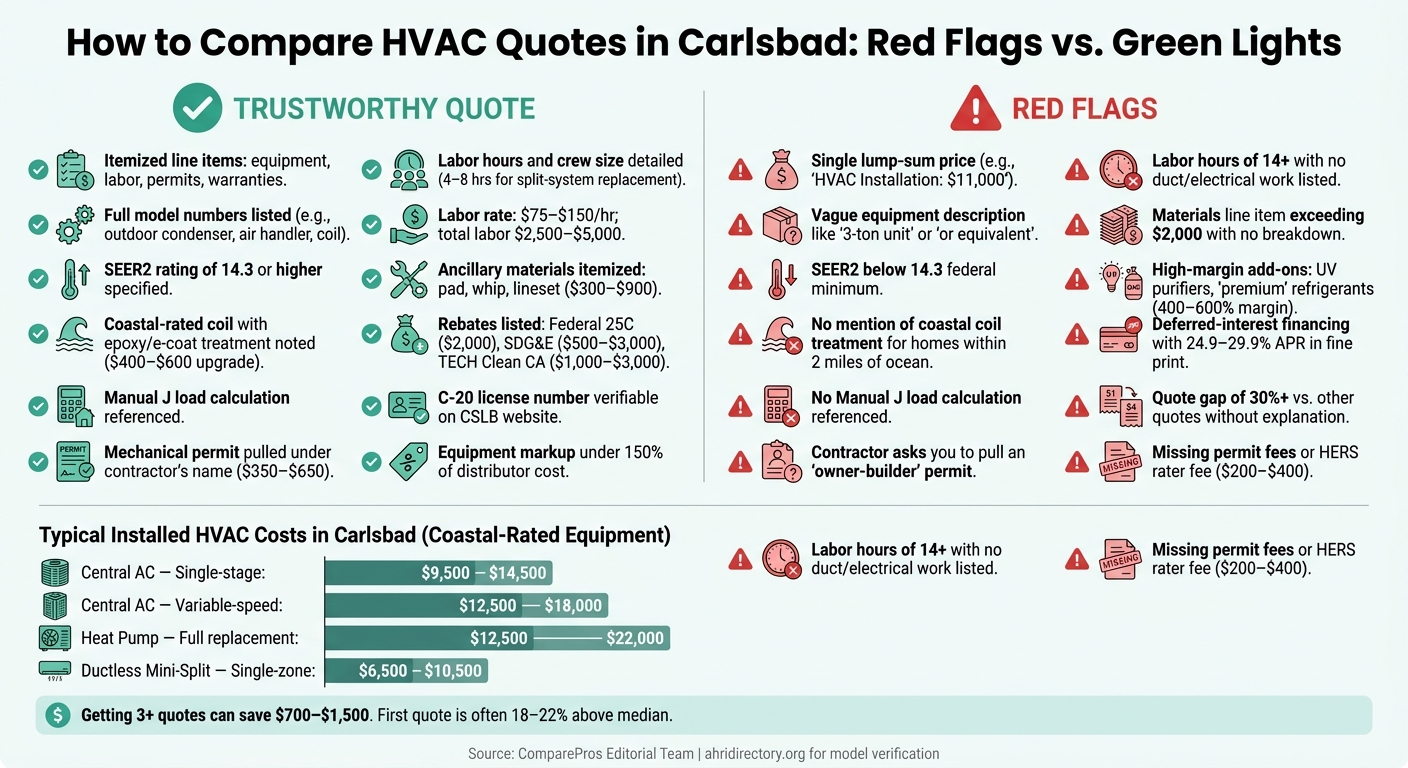
Carlsbad HVAC Quote Comparison: What to Check & What to Watch Out For
When you're evaluating HVAC quotes, it's essential to take a close look at the details. A low total price might seem appealing, but it could come with missing elements that cost more in the long run.
Making a Fair Side-by-Side Comparison
One common mistake is comparing quotes purely by their total price without ensuring the scope of work is the same. As mentioned earlier, you need to confirm that labor, equipment, and warranty details align across all quotes. For instance, make sure each quote is based on the same system tonnage determined by a Manual J load calculation, not just square footage estimates.
Check the hardware details carefully, including SEER2 ratings and any upgrades for coastal conditions. For example, a quote for a 14.3 SEER2 base system (typically priced between $6,800 and $9,500 installed) is not comparable to one for a 17+ SEER2 high-efficiency system, which usually costs between $10,000 and $13,500.
Additionally, go through the warranty terms in detail. A manufacturer's 10-year parts warranty is not the same as a contractor's labor warranty, which may range from just 1 year to as long as 10 years. A cheaper quote with only a 1-year labor warranty could end up being more expensive if repairs are needed later.
Using a checklist can help you organize these details and make sure you're comparing apples to apples.
Using a Checklist or Table to Stay Organized
Getting at least three quotes can save you between $700 and $1,500 on a typical HVAC replacement. Interestingly, the first quote is often 18–22% higher than the median price for the same job. To keep track of the details, a comparison table is incredibly useful:
| Comparison Category | Details to Check |
|---|---|
| Equipment | Brand, model number, tonnage, SEER2/HSPF2 ratings |
| Labor Scope | Removal of the old unit, replacement of line sets, electrical work |
| Warranties | Manufacturer parts (years) vs. contractor labor (years) |
| Financials | Base price, permit fees, rebates (instant vs. tax credit), net cost |
| Compliance | C-20 license number, proof of workers' comp and liability insurance |
| Coastal Specs | Explicit coastal coil treatment details |
Before signing any agreement, verify the contractor's C-20 license on the California CSLB website. Also, find out if they will handle rebate applications. Starting in 2026, homeowners in San Diego can combine several incentives: the Federal 25C Tax Credit (up to $2,000), SDG&E rebates ($500–$3,000), and TECH Clean California incentives ($1,000–$3,000) - but only if the paperwork is completed correctly.
Why Local, Family-Owned Companies Stand Out
Once you've compared the technical and financial details, think about the value of working with local, family-owned businesses. These companies often provide transparent, itemized pricing, which makes it easier to avoid hidden fees and markups.
Take Coastal Comfort San Diego as an example. They clearly separate costs for equipment, labor, permits, and materials, so you know exactly what you're paying for. Plus, their technicians aren't commission-based, meaning their recommendations are likely to be focused on what's best for you.
"When the person diagnosing your system and recommending solutions earns a commission on what they sell, their financial incentive and your financial interest are in direct conflict." - Brandon Kidd, J Martin IAQ
With over 30 years of experience in San Diego County, Coastal Comfort San Diego understands the local climate and often specifies coastal-rated equipment without needing to be asked. As they explain:
"As a family-owned business, we keep overhead low and don't rely on high-pressure sales or commissions. That means you get quality service without inflated pricing." - Coastal Comfort San Diego
This focus on clear and honest pricing is an important factor to consider when you're comparing HVAC quotes.
Conclusion: Making a Confident HVAC Decision
Here’s a quick recap to help you navigate your HVAC decision with confidence. Deciphering an HVAC quote doesn’t have to be overwhelming. The key is transparency: every legitimate quote should be itemized. That means separate line items for equipment, labor, permits, and warranties. If you’re presented with just a single lump sum, consider it a warning sign.
Before committing, double-check a few critical details: ensure the equipment specifications match, confirm that a Manual J load calculation was performed, and verify that the contractor is pulling the permit in their name. These steps aren’t just procedural; they safeguard your warranty, your investment, and your legal protection.
"A transparent company has nothing to hide, and their quote should reflect that." - J Martin IAQ
It’s normal to see a 10–20% difference between quotes. However, if you notice a gap of 30% or more, it’s worth investigating - this could indicate shortcuts like skipping permits or using lower-quality equipment. For those in coastal areas, such as Carlsbad, make sure the quote includes protective measures against salt-air corrosion. These small but significant checks can help you identify a quote you can trust.
Our approach is simple: itemized pricing, no commission-driven technicians, and over 30 years of local expertise. With every line item clearly laid out, you’ll know exactly what you’re paying for - and why.
FAQs
What should I ask for if an HVAC quote isn’t itemized?
If the quote doesn’t already include a detailed breakdown, ask for one in writing. It should cover equipment, labor, ancillary materials, permit/inspection fees, and warranty terms. Make sure it specifies the exact brand names, full model numbers, and efficiency ratings for key components like the outdoor unit, indoor unit, and evaporator coil. Labor costs and permit fees should also be listed separately. Avoid agreeing to any quote that lacks these crucial details.
How can I verify the model numbers and efficiency ratings in my quote?
To make sure the equipment listed in your quote meets your expectations, ask the contractor for specific details like the brand name, full model number, and efficiency ratings (such as SEER2, HSPF2, or AFUE). Be cautious of quotes that only include vague terms like "tonnage" without further explanation.
Use the AHRI directory to verify certifications and check the equipment's specifications. If the quote lacks these details, ask for a written revision before signing anything. This ensures clarity, allows you to independently confirm the system's value, and helps guarantee you're getting the quality you expect.
How do I know if I need coastal-rated HVAC equipment in Carlsbad?
If you live in Carlsbad and your home is within five miles of the ocean - which applies to much of the city - you’ll need coastal-rated HVAC equipment. The salty air near the coast can cause standard HVAC units to corrode faster, leading to issues with coils, connections, and finishes. While coastal-rated systems may cost 5–15% more initially, they’re built to handle these conditions. With protective coatings and marine-grade components, these systems are designed to resist corrosion, helping them last their full expected lifespan.