
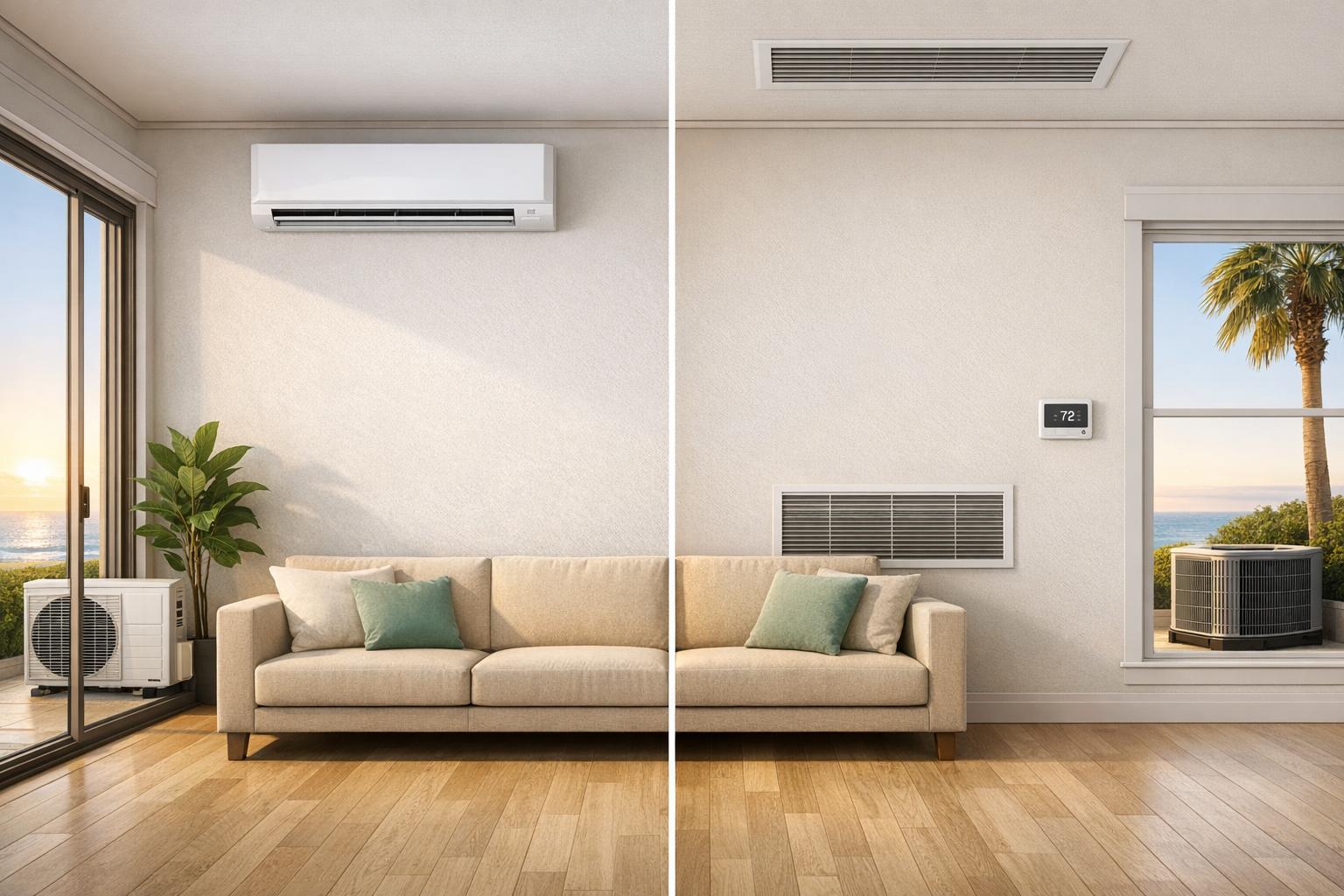
Mini-Split vs Central AC: A Carlsbad Homeowner's Guide
Choosing between a mini-split and central AC system for your Carlsbad home depends on factors like energy efficiency, installation needs, and coastal climate challenges. Mini-splits excel in homes without ductwork, offering room-specific temperature control and better energy efficiency. Central AC systems are ideal for larger homes with existing ductwork, providing whole-home cooling with a more discreet appearance. Both options require regular maintenance to combat Carlsbad’s salty air, which can accelerate corrosion.
Quick Comparison
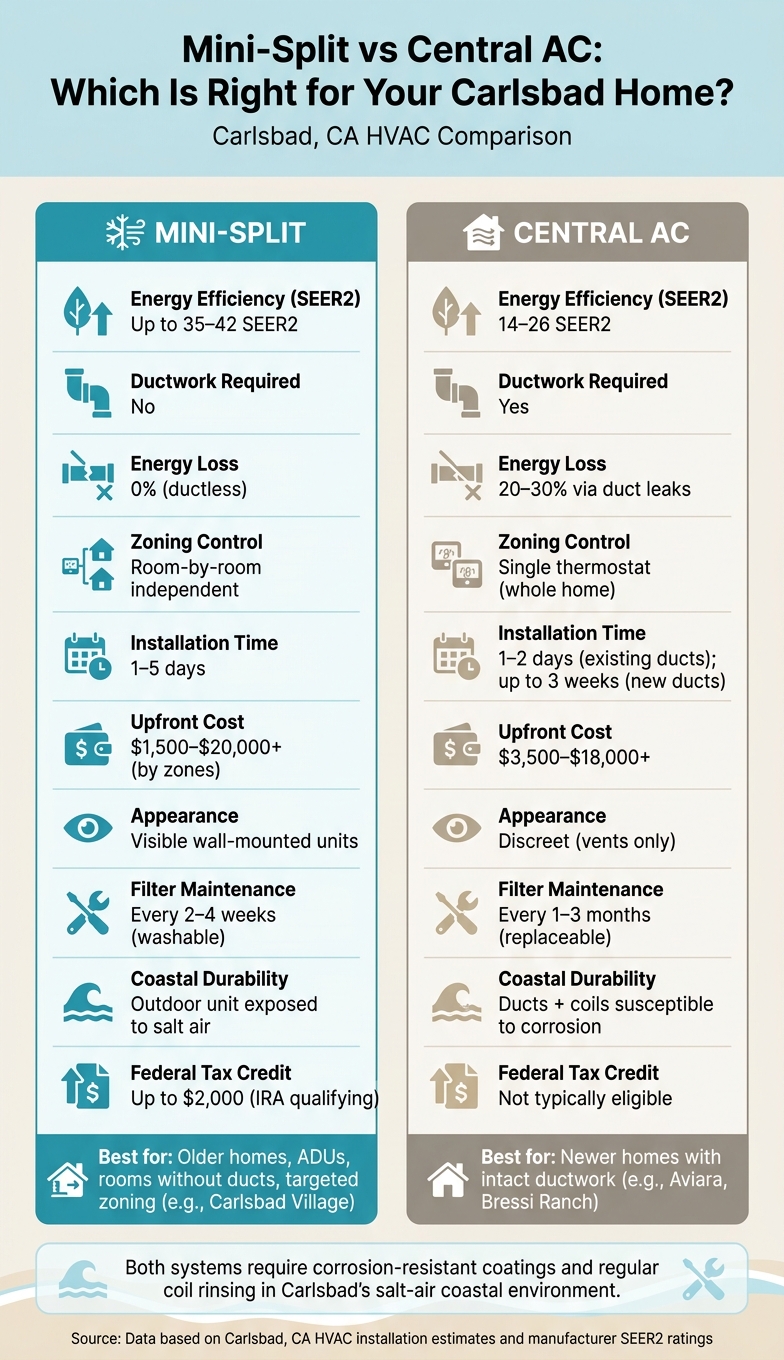
| Factor | Mini-Split | Central AC |
|---|---|---|
| Energy Efficiency | Higher (up to 35+ SEER2) | Moderate (14–26 SEER2) |
| Ductwork | Not required | Required |
| Zoning | Room-specific control | Single thermostat |
| Installation Time | 1–5 days | 1–2 days (with ducts) |
| Aesthetics | Visible indoor units | Discreet (vents only) |
| Cost Range | Higher upfront (multi-zone) | Lower if ducts are intact |
For older homes or those without ducts, mini-splits are a practical choice. If your home already has ductwork, central AC can be a simpler solution. Regular maintenance, including cleaning coils and filters, is crucial for both systems in Carlsbad’s coastal environment.
Mini-Split vs Central AC: Carlsbad Homeowner Comparison Guide
Carlsbad's Climate and How It Affects HVAC Performance
Key Climate Factors in Carlsbad
Carlsbad's Mediterranean climate brings its own set of HVAC challenges, largely due to its proximity to the Pacific Ocean.
The salt-laden air near the coast, especially within three miles of the ocean, accelerates wear and tear on outdoor HVAC components. As Earth Air Systems points out:
"The salt-laden air from the Pacific Ocean is highly corrosive. It can eat away at the delicate aluminum fins on your outdoor condenser coil and cause electrical components to fail prematurely." - Earth Air Systems
Coastal humidity and the frequent marine layer create persistent dampness, which can make maintaining indoor comfort tricky. Mini-split systems are particularly effective here since they include dedicated dehumidification features. While central AC systems also remove moisture, they may struggle with precision, especially if the system isn't perfectly sized for the home.
Carlsbad's extended cooling season, which runs from April through October, combined with mild winter lows averaging 45°F–50°F, reduces the need for heavy heating. This makes heat pump-based mini-splits an energy-efficient choice, as they transfer heat rather than generating it like a gas furnace.
However, central AC systems face their own challenges. Leaky ductwork can lead to a 20%–30% loss of conditioned air, particularly when ducts are routed through hot attics or damp crawlspaces. These unique climate factors play a critical role in determining whether a mini-split or central AC system is the better fit for Carlsbad homes.
Common Home Types in Carlsbad and Their HVAC Needs
The variety of homes in Carlsbad also influences HVAC choices. In older homes found in Carlsbad Village, which often lack attics, ductless mini-splits are a practical solution. These systems require only a small 3-inch hole for installation, avoiding the need for extensive ductwork that could damage original architectural details. Additionally, multi-level homes in this area benefit from the zoning flexibility of mini-splits, which can address temperature differences between floors.
On the other hand, newer neighborhoods like Aviara and Bressi Ranch were designed with ductwork already in place. For these homes, central AC systems or ducted heat pumps are a more straightforward option. If the existing ductwork is in good shape, upgrading the equipment is typically more cost-effective than installing an entirely new system.
Neighborhoods slightly inland, such as La Costa and Calavera Hills, experience more noticeable temperature fluctuations compared to coastal areas. In these cases, the zoning capabilities of mini-splits can help maintain consistent comfort throughout the home. Ultimately, the choice between mini-split and central AC systems depends on the home's layout and the specific environmental conditions of the area. This balance of factors also plays into considerations around cost and energy efficiency, which will be explored further.
sbb-itb-a7630c3
Mini-Split Systems for Carlsbad Homes
Benefits of Mini-Split Systems
Mini-split systems are a great fit for Carlsbad homes, offering impressive zoning flexibility and energy efficiency. Each indoor unit works independently, allowing you to set different temperatures in different rooms. As ServiceMag points out:
"The biggest efficiency gain from mini-splits isn't the SEER2 rating - it's zoning. With central air and a single thermostat, you're cooling the whole house to maintain the bedroom temperature at 11 PM, even though nobody's in the living room."
This zoning capability is especially handy in multi-level homes, where keeping temperatures consistent across floors can be tricky. Another major plus? Mini-splits don’t require ductwork, avoiding the 20%–30% energy loss that’s common with ducted systems. In a city like Carlsbad, where electricity rates rank among the highest nationwide, this efficiency can lead to noticeable monthly savings.
Top-tier mini-split models boast SEER2 ratings of up to 42, far outperforming the 14–26 SEER2 range typical of central AC systems. Additionally, heat pump mini-splits that qualify under the Inflation Reduction Act can earn homeowners up to $2,000 in federal tax credits.
For older homes in Carlsbad Village that lack existing ductwork, mini-splits provide a minimally invasive solution. Installation requires only a small wall penetration, avoiding the hassle of dropped ceilings or lost closet space. Plus, indoor units operate quietly, with noise levels ranging from 19 to 52 decibels - quieter than most conversations.
While these features make mini-splits a standout choice, there are some downsides to consider.
Drawbacks of Mini-Split Systems
One of the most common complaints about mini-splits is their appearance. Wall-mounted air handlers are visible, which some homeowners find less attractive than the subtle vents of central systems. While ceiling-recessed or floor-mounted units offer a more discreet design, these options often come with higher installation costs.
The exterior aesthetics can also be a concern. Refrigerant lines running along outside walls are visible, and some homeowners' associations in Carlsbad have rules about such installations. However, skilled installers can route these lines more discreetly or use paintable covers to blend them into the home’s exterior.
Maintenance is another factor to weigh. Mini-split filters need cleaning every 2–4 weeks, which is more frequent than the monthly or seasonal filter changes required by central AC systems. Additionally, the upfront cost for whole-home coverage can be steep. A 4- or 5-zone system can range from $9,000 to over $20,000 installed, sometimes exceeding the cost of central AC in homes with existing ductwork in good shape.
Mini-Split Installation and Costs
Carlsbad’s coastal climate and varied home designs make proper installation and cost planning essential. Installing a single-zone mini-split usually takes 4–8 hours, while a multi-zone system for an entire home can take 1–5 days. Costs depend on the number of zones and the complexity of the layout:
| System Type | Installed Cost Range |
|---|---|
| Single-zone | $1,500 – $5,000 |
| 2-zone | $4,500 – $8,000 |
| 3-zone | $7,000 – $12,000 |
| 4-zone | $9,000 – $15,000 |
| 5-zone and larger | $12,000 – $20,000+ |
For homes without existing ductwork, these costs are often more affordable than central AC, where adding new ductwork alone can cost $10,000 to $18,000.
Professional installation is a must, especially in California. The state requires a licensed C-20 HVAC contractor to ensure compliance with Title 24 energy standards and local Carlsbad permitting rules. Proper outdoor unit placement is also critical. It must meet noise ordinances, setback requirements, and be equipped with corrosion-resistant coatings to withstand Carlsbad’s salty coastal air. Finally, ensuring the system is correctly sized through a Manual J Load Calculation prevents future issues like short-cycling or poor humidity control.
Central AC Systems for Carlsbad Homes
Benefits of Central AC Systems
Central air conditioning provides comprehensive cooling for larger homes in Carlsbad, especially those with existing ductwork. One of its standout features is how it blends seamlessly into the home’s design - only the vents are visible, keeping walls and décor untouched. This is particularly appealing in neighborhoods with open layouts and high ceilings.
Another advantage is improved indoor air quality. Central systems can easily pair with HEPA filters and UV light purifiers, which are especially useful in Carlsbad’s humid, coastal environment. Plus, having a single thermostat to control the entire home simplifies temperature management for families.
Properly sized systems also help manage humidity levels, keeping the home comfortable even during muggy weather.
But while central AC has its perks, there are some challenges to consider.
Drawbacks of Central AC Systems
One of the main challenges with central AC is its reliance on ductwork. If the ducts are old or leaky, they can waste a lot of energy - something to watch out for in older homes. Multi-story homes often face uneven cooling, with upstairs rooms staying warmer because the thermostat is usually located on the lower level.
Another downside is limited zoning. Without upgrades like motorized dampers and extra thermostats, central AC cools the entire house at once, including rooms that aren’t in use. Retrofitting to create basic zoning can cost between $2,500 and $5,500, while a full re-zone - needed if the ducts are damaged or too small - can range from $9,000 to $12,000.
Coastal living also brings its own challenges. Salt air can accelerate corrosion on outdoor condenser units, a process called coil pitting. Without annual professional cleaning to remove salt buildup, the lifespan of an AC unit in Southern California’s coastal areas may drop below the typical 10–12 years.
Central AC Installation and Costs
Weighing the pros and cons of central AC can help you understand the installation process and costs involved. If your home already has functional ductwork, installation usually takes one to two days and costs between $5,500 and $12,000, depending on the system’s size and efficiency. However, if new ducts are needed, the timeline can stretch to three weeks, with total costs climbing to $10,000–$18,000 or more.
Here’s a quick cost breakdown based on home size:
| Home Size (Sq. Ft.) | Recommended Tonnage | Estimated Cost (Existing Ducts) |
|---|---|---|
| Up to 1,100 | 2-ton | $3,500 – $6,000 |
| 1,100 – 1,800 | 3-ton | $4,500 – $7,500 |
| 1,800 – 2,500 | 4-ton | $5,500 – $9,000 |
| 2,500 – 3,500 | 5-ton | $7,000 – $12,000 |
A thorough duct inspection is essential since even the most efficient AC system won’t perform well with leaky ducts. Coastal Comfort San Diego offers a Manual J Load Calculation to properly size your system, reducing the risk of short-cycling - a common issue that hampers dehumidification in Carlsbad’s humid climate. For homes near the ocean, investing in equipment with epoxy-coated coils or similar protective features can significantly extend the system’s life.
Older homes in Carlsbad might also require an electrical panel upgrade - from 100 amps to 200 amps - to support the 240V circuit needed for central AC. It’s a good idea to include this in your budget from the start.
Mini-Split vs Central AC: Which One Fits Your Carlsbad Home?
Key Summary Comparison: Mini-Split vs Central AC
Both central AC and mini-split systems can be great options for homes in Carlsbad, but they’re designed with different needs in mind. Here’s a side-by-side look at how they stack up on the factors that matter most to homeowners in the area:
| Factor | Central AC | Mini-Split |
|---|---|---|
| Efficiency | 14.3–26 SEER2 | Up to 35–38+ SEER2 |
| Energy Loss | 25–30% due to duct leaks | None (ductless design) |
| Humidity Control | Excellent for whole-home dehumidification | Effective for specific rooms but less so for an entire home |
| Appearance | Discreet (vents only) | Visible wall-mounted indoor units |
| Installation Time | 1–2 days (if ducts exist); up to 3 weeks for new ductwork | Usually 1–5 days |
| Upfront Cost | Roughly $5,500–$18,000+ | Roughly $2,500–$20,000+, depending on the number of zones |
| Coastal Durability | Susceptible to duct and coil corrosion | Outdoor units may be impacted by salt air |
| Zoning | Single thermostat for the entire home | Independent control for individual rooms or zones |
While premium mini-split systems can hit efficiency ratings of 35 SEER2 or higher, central AC systems typically max out in the mid-20s. But efficiency ratings alone don’t paint the full picture - how you plan to use your system plays a big role in determining which one is the better fit.
Carlsbad Scenarios: When to Choose Each System
Your home’s layout and existing infrastructure often dictate which system is the better choice.
For homes with existing ductwork, central AC is often the simpler, more affordable option. Many newer neighborhoods in Carlsbad, like Aviara and Bressi Ranch, already have HVAC systems in place, making central AC upgrades relatively easy.
On the other hand, older homes in areas such as Carlsbad Village or Old Carlsbad often lack ductwork altogether. In these cases, mini-splits are ideal since they eliminate the need for expensive duct installations. They’re also a perfect match for accessory dwelling units (ADUs) or garage conversions, offering precise temperature control without requiring a full ducted system.
For homes with specific problem areas - like an overly warm upstairs bedroom or a sun-drenched office - some homeowners opt for a hybrid solution. This involves keeping central AC for the main living spaces while adding a single-zone mini-split to target those tricky spots.
No matter which system you lean toward, it’s crucial to have a professional conduct a Manual J Load Calculation. This ensures your HVAC system is properly sized, taking into account factors like Carlsbad’s coastal humidity, insulation levels, and sun exposure.
Up next, dive into long-term costs, efficiency, and maintenance to make the most informed decision for your home.
Costs, Efficiency, and Maintenance Over Time
Long-Term Costs and Energy Use
San Diego County residents face some of the steepest electricity rates in the nation, which means your HVAC system's efficiency plays a big role in your monthly energy bills. Central air conditioning systems often lose energy due to duct leaks - especially when those ducts run through a hot attic. In contrast, mini-splits deliver air directly into rooms, eliminating duct-related energy loss entirely. This difference can translate into real savings: a high-efficiency mini-split can reduce annual energy costs for a typical 2,000 sq. ft. Southern California home by $100–$250, thanks to its variable-speed compressors that adjust output continuously rather than cycling on and off.
That said, mini-splits come with a higher upfront cost. Installing a multi-zone system typically ranges from $9,000–$15,000, with a payback period of 8–15 years. If your home already has well-maintained ductwork, upgrading to central AC might be the more budget-friendly option, costing between $3,000–$12,000. On the bright side, federal tax credits under the Inflation Reduction Act can provide up to $2,000 for qualifying high-efficiency heat pumps, helping to offset some of the cost of a mini-split system. To maximize these savings, regular maintenance is crucial - especially in Carlsbad’s coastal climate, where environmental conditions can impact system performance over time.
Maintenance in a Coastal Environment
Living near the coast has its perks, but it also brings challenges for HVAC systems. Carlsbad’s salty air speeds up corrosion, causing aluminum coil fins and copper tubing to deteriorate 3–5 times faster than in inland areas. Without proper protection, outdoor units might last only 10–12 years. To combat this, many manufacturers offer units with epoxy-coated coils - often branded as "Gold Fin" or "Blue Fin" coatings - that help resist salt damage and extend the system's lifespan. For homes within 1–3 miles of the ocean, some manufacturers even require a special seacoast warranty to cover salt-air corrosion, so it’s worth discussing this detail during installation.
Routine maintenance for these systems also differs. Mini-split filters are washable and should be cleaned every 2–4 weeks to maintain airflow and prevent odors caused by moisture buildup. Central AC systems, on the other hand, require filter replacements every 1–3 months, and ducts should be cleaned professionally every few years to reduce allergen buildup. For both types of systems, regularly rinsing outdoor coils with fresh water - monthly or quarterly - can prevent salt crystals from causing damage. A professional tune-up, ideally twice a year (before summer and winter), is also recommended to check refrigerant levels and ensure the coils are thoroughly cleaned. Staying on top of these tasks not only keeps your system running efficiently but also helps extend its lifespan.
How Coastal Comfort San Diego Supports Your System

Coastal Comfort San Diego brings over 30 years of experience in handling the unique HVAC challenges posed by Carlsbad’s salty air and humid conditions. Unlike generic maintenance plans designed for inland homes, they tailor their services specifically for coastal environments.
They provide same-day service, offer flexible financing options with 0% APR, and even have a price match guarantee to help homeowners manage long-term HVAC costs more effectively. Whether you’re looking to maintain your current system or considering a full replacement, working with a technician who understands the specific demands of Carlsbad’s coastal climate can make a noticeable difference in your system’s efficiency and longevity.
Mini Split Vs Central AC: The TRUTH About Cooling Your Home
Conclusion
Deciding between mini-split and central AC systems depends on your home's specific needs and the challenges posed by the coastal environment. The right choice often boils down to factors like your home's layout, budget, and how much control you want over individual room temperatures. If you own a larger Carlsbad home with existing ductwork and prefer seamless whole-home cooling, central AC is a solid option. On the other hand, mini-splits shine in older homes without ducts, ADUs, or for targeted cooling in areas like west-facing bedrooms that heat up in the afternoon, while the rest of the house enjoys natural ocean breezes.
Both systems must contend with Carlsbad's coastal conditions, which means investing in units with protective coatings and committing to regular maintenance is crucial.
As one satisfied customer shared:
"As a family-owned business, we keep overhead low and don't rely on high-pressure sales or commissions. That means you get quality service without inflated pricing." - Coastal Comfort San Diego
Coastal Comfort San Diego, a family-owned business with over three decades of experience, offers free estimates, 0% APR financing, and a price match guarantee to make cooling solutions more accessible. Whether you're replacing an old system or installing one for the first time, working with a local expert who knows the ins and outs of Carlsbad's neighborhoods can save you from costly mistakes. Take the time to assess your home's needs and consult a trusted professional to find the ideal cooling solution for Carlsbad's unique coastal climate.
FAQs
How do I know what size (tonnage) AC my Carlsbad home needs?
When it comes to air conditioning, size isn’t just about the square footage of your home - it’s measured in tons, with one ton equaling 12,000 BTUs per hour. Why does this matter? Because getting the wrong size can lead to big issues.
An oversized unit cools your home too quickly, which might sound great at first. But the rapid cooling doesn’t allow enough time to remove excess humidity, leaving your home feeling damp and uncomfortable. On the other hand, an undersized unit struggles to keep up, working harder than it should and wasting energy in the process.
For homes in Carlsbad’s coastal climate, a precise AC size is crucial. That’s where a Manual J load calculation comes in. This professional assessment takes into account several factors, such as:
- Ceiling height and layout: High ceilings or open floor plans can affect cooling needs.
- Insulation and windows: Poor insulation or large windows can let heat in, increasing demand.
- Ductwork and internal heat sources: Inefficient ducts or appliances like ovens and computers add extra heat.
These details ensure your AC system is perfectly tailored to your home, keeping it cool, comfortable, and energy-efficient.
What coastal-protection features should I look for to prevent salt-air corrosion?
To protect your equipment from salt-air corrosion in Carlsbad, look for systems with features designed to withstand harsh coastal conditions. For example, condenser coils coated with epoxy, acrylic, or polymer materials (like Gold Fin or Blue Fin) provide an added layer of defense. Choose galvanized steel cabinets with baked-on powder-coat finishes for durability, and make sure any exposed fasteners are made of stainless steel to resist rust. Additionally, materials like aluminum coils or copper-nickel alloys offer better corrosion resistance compared to standard copper, making them ideal for marine environments.
Can I combine central AC with a mini-split for one problem room?
Absolutely! Pairing a central AC system with a mini-split is a smart solution for tackling comfort issues in specific parts of your home. This setup works particularly well for spaces like home offices, converted garages, or sunrooms - areas that are often tricky to cool effectively with traditional ductwork.
A mini-split lets you control the temperature independently in those problem spots, eliminating the need to extend ductwork or risk overcooling the rest of your home. It’s a practical way to keep your entire house comfortable without compromising efficiency or comfort.