
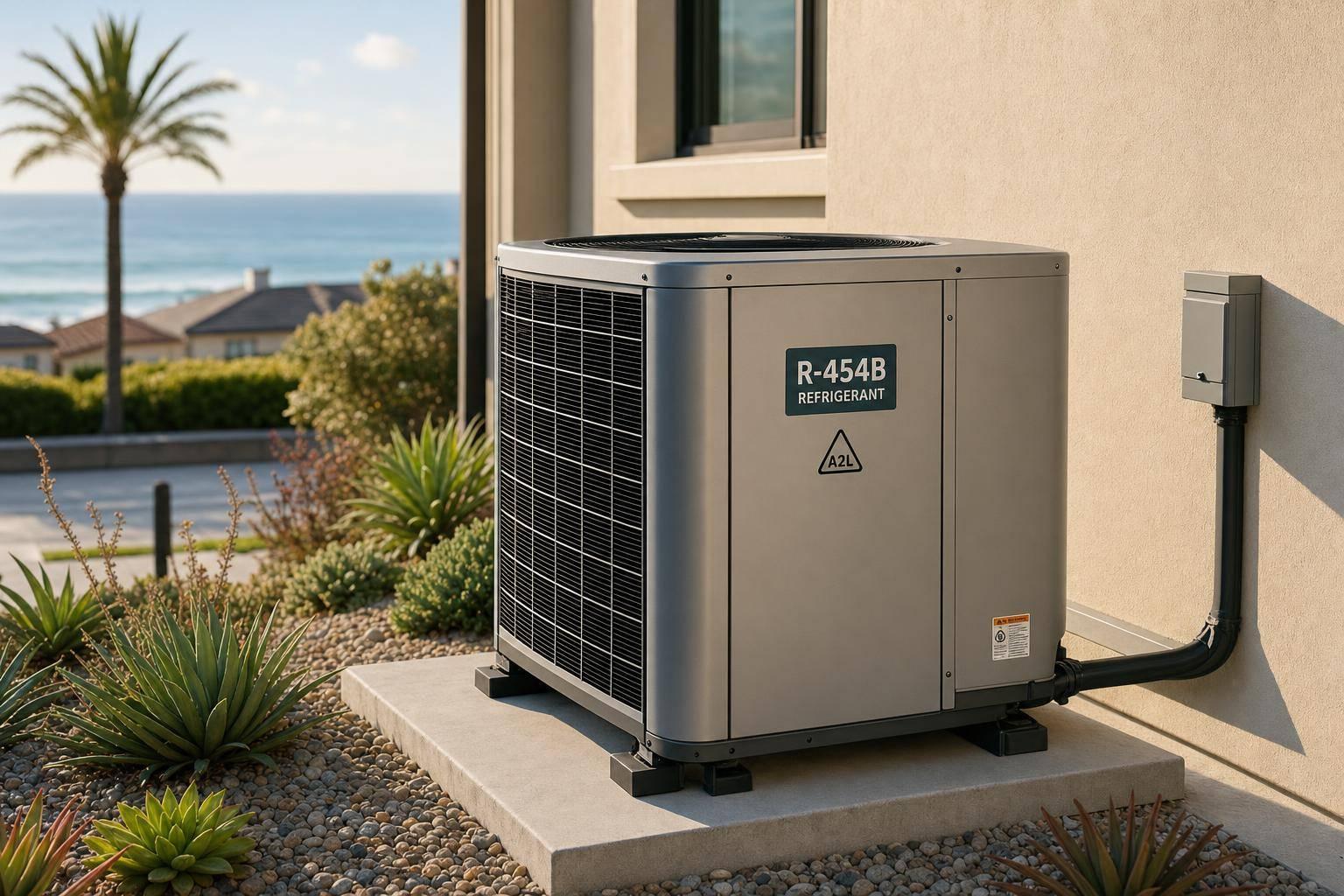
R-454B Refrigerant: What Carlsbad Homeowners Need to Know in 2026
If I’m replacing a home AC or heat pump in Carlsbad in 2026, I should expect the new system to use R-454B, not R-410A. That’s because new residential equipment shifted after the January 1, 2025 rule change. My current R-410A system can still be serviced, but it can’t be converted to R-454B.
Here’s the short version:
- R-454B is now common in new systems
- R-410A still works in existing equipment
- R-454B has a much lower GWP: about 466 vs. 2,088
- R-454B is an A2L refrigerant, which means mildly flammable
- A2L systems need the right installation and service steps
- Coastal salt air in Carlsbad can shorten equipment life
- If my system is older or has a big repair need, replacement may make more sense than another fix
What matters most is simple: keep a working R-410A system if it’s still in good shape, but plan ahead if it’s aging, leaking, or having major failures. For many homeowners, the decision comes down to repair now or replace with an R-454B system built for current code and service standards.
| Topic | Existing R-410A System | New R-454B System |
|---|---|---|
| What I can do in 2026 | Keep and service it | Install it as new equipment |
| Refrigerant changeover | Cannot switch to R-454B | Built for R-454B from the start |
| GWP | ~2,088 | ~466 |
| Safety class | A1 | A2L |
| Carlsbad concern | Age, leaks, corrosion | Correct install, sensor checks, coastal wear |
If I’m comparing repair vs. replacement, the main things to check are system age, leak history, compressor condition, and salt-air corrosion.
Part 1: R-454B & R-32 Installation Basics - Webinar 7/28/25
sbb-itb-a7630c3
R-454B Basics for California Homes
R-454B is a blend of R-32 and R-1234yf made for lower GWP in new systems. For homeowners, that changes what you’ll be able to buy, install, and service next.
In new equipment, it delivers home comfort that’s similar to R-410A, but with lower GWP. There’s one point that matters a lot: R-454B cannot be added to an R-410A system. It’s made for equipment built around its own pressure, performance, and safety needs. That’s why the A2L label matters.
What A2L Means in Plain Terms
This is the part that tends to make people pause. But once you break it down, it’s pretty simple.
The “A” means the refrigerant is non-toxic. The “2L” means it is mildly flammable. That’s different from R-410A, which has an A1 rating, meaning nonflammable.
“Mildly flammable” doesn’t mean unsafe for normal home use. R-454B is hard to ignite under normal conditions. And systems built for A2L refrigerants come with safety measures like:
- leak detection sensors
- better cabinet ventilation
- electrical parts designed to help prevent sparks
So what does that mean in plain English? If the system is installed and serviced the right way, the mild flammability is an engineering issue that the equipment is built to handle, not a day-to-day household risk.
The next piece is how the 2025 cutoff affects new equipment in Carlsbad.
Why the Industry Is Moving Away From R-410A
Because R-454B is an A2L refrigerant, rules for new equipment changed in 2025. R-410A is being phased down under federal refrigerant rules, and California has also adopted A2L-ready building codes to support these newer refrigerants in residential systems.
If you already have an existing system, this shift doesn’t change how it runs day to day. The bigger impact shows up when it’s time to replace equipment. So if you’re weighing a repair or planning a new install in 2026, it makes sense to start with the basics: what R-454B is, how installation changes, and what it means for safety and cost.
How 2025-2026 Rules Affect New HVAC Systems in Carlsbad
In 2026, new Carlsbad AC and heat pump systems are generally built around R-454B, not R-410A. That change started on January 1, 2025, when new rules set lower global-warming-potential limits and pushed new residential systems away from R-410A.
During the changeover, a small number of R-410A systems were still installed. But by 2026, R-454B is the main option for new installs. For homeowners, the takeaway is pretty simple: if you're getting new equipment quotes in 2026, the specs will usually be built around R-454B.
What Changed on January 1, 2025, and What It Means in 2026
The 2025 cutoff applies to new equipment, not to systems already sitting in homes. So if you're replacing a ducted central system in Carlsbad in 2026, it's typically going to be an R-454B system.
That means when you ask for an estimate, you'll usually see R-454B listed in the equipment specs and quote. In plain English, the paperwork now looks different because the new equipment does too.
What Stays the Same for Existing R-410A Systems
The 2025 rules do not require you to replace a working R-410A system. Existing systems are still fully legal to own, operate, maintain, and repair. There is no deadline that forces Carlsbad homeowners to replace a working unit just because it uses R-410A.
What does change is the long-term math. As industry-wide production of R-410A winds down, supply will gradually get tighter. Right now, routine service and repairs are still allowed. But supply can become a bigger issue as a system gets older, especially if it develops a leak or needs a recharge.
That leads to the next call many homeowners face: repair an older R-410A system or plan for an R-454B replacement.
Your Current System vs. a New R-454B Replacement
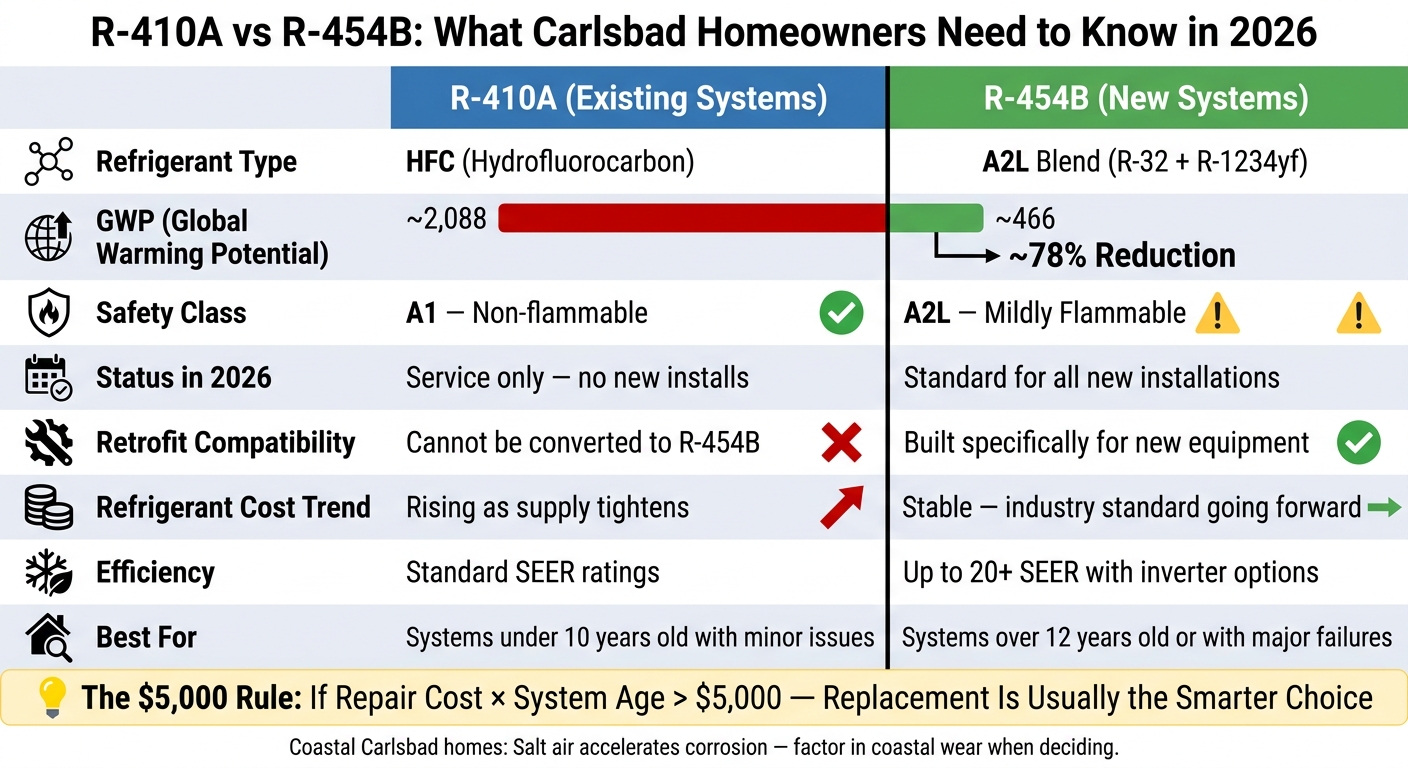
R-410A vs R-454B Refrigerant: Side-by-Side Comparison for Homeowners
Start by checking the outdoor unit label or your service records to confirm which refrigerant your system uses. If it uses R-410A, it stays R-410A until you replace the system. R-454B is not a drop-in replacement for R-410A equipment. Once you know the refrigerant, the next call is pretty simple: is this system worth fixing one more time, or is it smarter to replace it?
When Repairing an R-410A System Still Makes Sense
If your system is under warranty or still fairly new, especially if it's under 10 years old, and the problem is minor, repair is usually the better move. That can include a failed capacitor, a small easy-to-reach leak, or a refrigerant recharge .
Routine service for R-410A systems is still available, and a basic diagnostic plus recharge usually costs a few hundred dollars. For a newer unit, that's often money well spent. One thing to watch, though: R-410A costs are going up as supply gets tighter.
If you're dealing with repeat repairs, or the unit is more than 10 years old, replacement starts to look like the smarter path.
When Full Replacement Is the Better Long-Term Choice
In Carlsbad, salt air can speed this up because outdoor parts tend to corrode sooner. So a system that might limp along in another area can wear out faster near the coast.
If your unit has repeated leaks or a failed compressor, replacement often makes more sense. A simple rule many homeowners use is the $5,000 rule: if the repair cost × system age is more than $5,000, replacement is usually the better option.
New R-454B systems also often reach 20+ SEER. That means better efficiency than many older units, which can make a new system the stronger long-term pick. If replacement is on the table, the next step is looking at installation, safety, and total cost.
R-410A Systems vs. New R-454B Systems: Side-by-Side Comparison
| Feature | R-410A Systems | New R-454B Systems |
|---|---|---|
| Refrigerant Type | HFC (Hydrofluorocarbon) | A2L blend |
| Typical Use in 2026 | Existing systems; service only | Standard for new installations |
| GWP | ~2,088 | ~466 |
| Safety Class | A1 (Non-flammable) | A2L (Mildly flammable) |
| Retrofit Compatibility | Not compatible with R-454B | Not a drop-in replacement |
| Service Status | Available, but costs are rising | Widely available for new equipment |
| Efficiency | Standard SEER ratings | High-efficiency (often 20+ SEER) |
Installation, Safety, Service, and Cost Planning in San Diego County
If replacement is on the table, the next step is figuring out how R-454B changes installation, service, and overall cost.
What Changes During Installation and Maintenance
If you're replacing an HVAC system, R-454B changes both the equipment and the way the job gets done. Since R-454B is an A2L refrigerant, technicians need A2L training and tools approved for A2L systems.
In Carlsbad, salt air is hard on HVAC equipment. It speeds up corrosion on coils, fasteners, and electrical connections, so the copper line set between the indoor and outdoor units should be checked before installation. In some cases, it needs a flush or full replacement. That makes a pre-install inspection even more important, especially near the coast.
System sizing matters too. In coastal homes, an oversized unit can short-cycle and leave rooms feeling cool but damp. A qualified installer should run a Manual J load calculation that factors in Carlsbad's coastal humidity, not just the home's square footage. It also helps to schedule service twice a year so a technician can catch corrosion early and verify that leak-detection sensors are working as intended.
What Carlsbad Homeowners Should Expect to Pay
New R-454B systems usually cost more upfront than older-generation equipment, and the biggest drivers are system size and efficiency rating, including SEER2 and HSPF2.
The final installed cost in Carlsbad also depends on the condition of the rest of the system. Duct repairs, a line-set flush or replacement, and electrical upgrades can all change the final number. Space limits can matter too. Many Carlsbad condos and townhomes have tight side yards or limited attic space, which may call for compact equipment. Before you move ahead, check the parts and labor warranty terms closely.
Keep an Older R-410A System or Replace With R-454B: Cost and Risk Comparison
| Factor | Legacy R-410A (Repair) | New R-454B (Replacement) |
|---|---|---|
| Upfront Cost | Lower ($400–$4,000 for major repairs) | Higher (full system replacement) |
| Future Refrigerant Cost | Increasing as the phase-down continues | Lower long-term; industry standard going forward |
| Energy Efficiency | Declines with age | Up to 20 SEER with inverter options |
| Repair Risk | Higher; secondary failures are common | Lower; new parts warranty helps |
| Coastal Durability | Vulnerable if existing corrosion is present | Better with corrosion-resistant coatings |
| Best-Fit Scenario | Systems under 10 years old with minor issues | Systems over 12 years old or major failures |
Those differences can make the repair-versus-replace call feel pretty clear in some homes and much tougher in others.
Conclusion: Key Decisions for Carlsbad Homeowners in 2026
R-454B is the standard refrigerant for new residential AC and heat pump systems in 2026. Existing R-410A systems can still be serviced, but they can't be converted to R-454B. For most homeowners, that narrows the decision to one thing: fix the system you have or start planning for a replacement.
Start by checking the outdoor unit data plate or your recent service records to confirm which refrigerant your system uses. That single detail shapes the next move. It tells you whether basic maintenance, a focused repair, or a full system swap makes the most sense.
If your system is older or keeps giving you trouble, let the numbers guide the call. Use the $5,000 rule: if repair cost × system age is more than $5,000, replacement usually comes out ahead. In Carlsbad, salt air and humidity can speed up corrosion on coils and electrical parts, which is why systems older than 10 to 12 years often make more sense as replacement candidates.
For Carlsbad homes, coastal wear can push that timeline up. A professional evaluation can confirm the refrigerant type, check for corrosion from the coast, and help you see whether repair or replacement is the better next step.
FAQs
How do I know if my system uses R-410A or R-454B?
Check the nameplate or label on your outdoor condenser unit. In most cases, it shows the refrigerant type - such as R-410A or R-454B - along with the model and serial numbers.
If the label is hard to spot or the details aren’t clear, an HVAC technician can verify the refrigerant during a routine maintenance visit or service call.
Will R-410A repairs become more expensive over time?
Yes. Repairs on older systems, including units that use R-410A, often get more expensive over time. Parts can be harder to find, which can lead to longer wait times and higher repair bills.
A major refrigerant leak is a good example. Once you add up the refrigerant, labor, and coil replacement, the total can get close to the cost of a new unit. If major repairs come out to more than 30% to 40% of what a new system would cost, replacement is often the better financial move.
Do I need a special technician for an R-454B system?
Yes. R-454B systems should be handled by a qualified, licensed HVAC contractor with technicians trained and certified for newer refrigerants.
For service or installation, check that the technician is EPA-certified, follows the required pressure-testing and safety steps, and works for a contractor that is fully licensed and insured.