
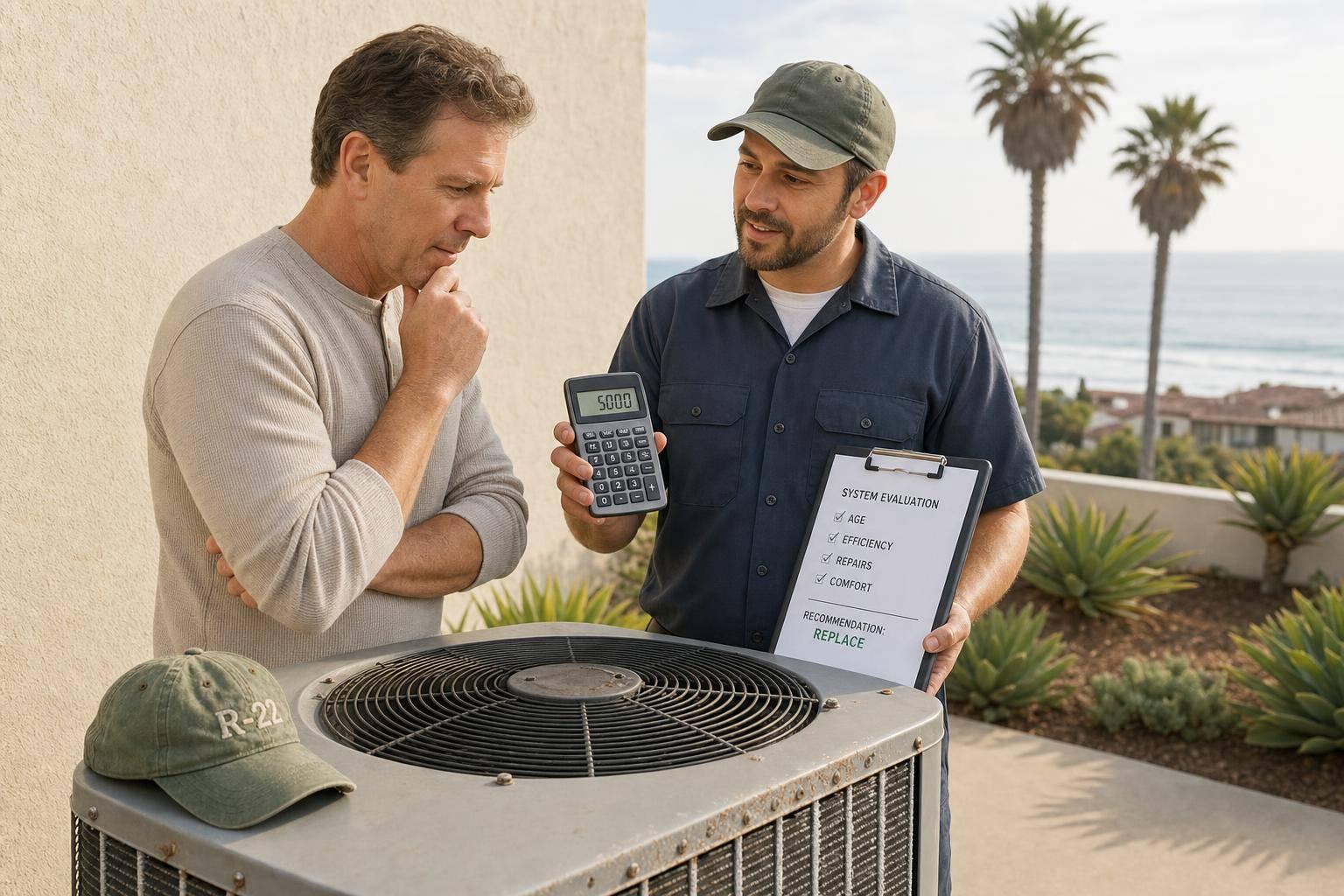
Repair vs Replace: When the Math Says Replace in Carlsbad
If your AC is older, corroded, uses outdated refrigerant, or keeps breaking down, replacement often makes more sense than another repair. In Carlsbad, salt air can shorten AC life, so the tipping point can come sooner than many homeowners expect.
Here’s the short version:
- I’d lean toward replacement when the system is around 10 to 15 years old, has had 2 or more major repairs in 3 years, or struggles with airflow, humidity, or cooling.
- I’d look closely at the age × repair bill rule: if that number is over 5,000, replacement is often the better call.
- A unit near the coast may wear out faster because salt air corrosion can damage coils, fins, and metal parts.
- Older systems can use 25% to 30% more energy than newer equipment.
- R-22 is a major red flag, and older R-410A systems can also get harder to justify when refrigerant work is needed.
- An expired warranty can turn one breakdown into a long string of out-of-pocket bills.
Quick Comparison
| Factor | Repair | Replace |
|---|---|---|
| System age | Better fit for newer units | Often the better move for older units |
| Repeat breakdown risk | Higher on aging systems | Lower at the start |
| Energy use | Usually higher | Usually lower |
| Refrigerant issues | Can be a problem on older units | Less concern with new equipment |
| Carlsbad salt air | Corrosion may keep getting worse | New start with new parts |
| Warranty | May be expired | Usually comes with long parts coverage |
If I were making this call, I wouldn’t look at today’s fix alone. I’d look at what the system is likely to cost me over the next few years in service calls, power use, and cooling problems.
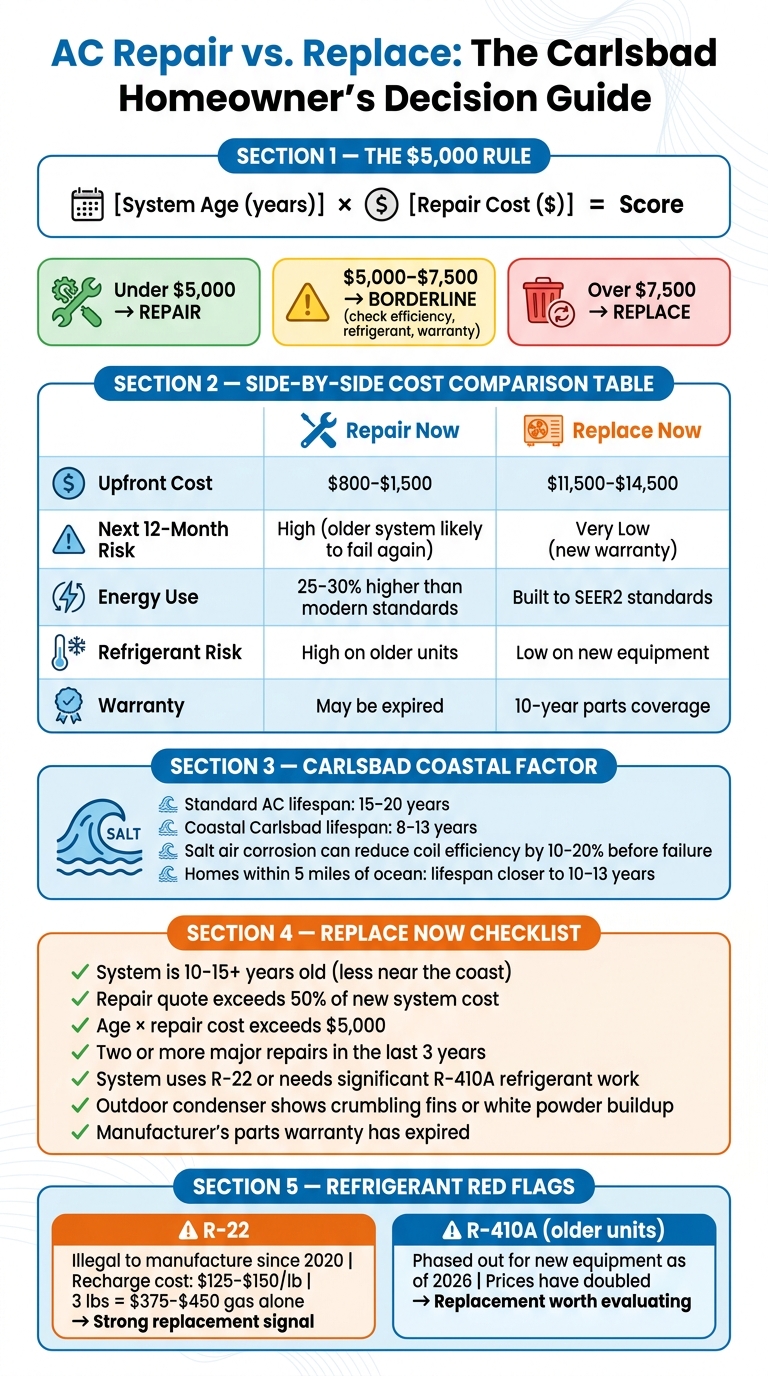
AC Repair vs. Replace: Cost & Decision Guide for Carlsbad Homeowners
HVAC Repair vs. Replacement Cost: The $5,000 Rule Explained
sbb-itb-a7630c3
Repair Cost vs. Replacement Cost
Don’t look at today’s repair bill by itself. The better way to judge this is to compare the quote in front of you with what the system is likely to cost over the next 1 to 3 years. Once you do that, the next move usually gets a lot clearer.
Add Today's Bill to Your Likely Costs Over the Next Few Years
When you stack up repair vs. replacement, the honest math goes past today’s invoice. You also need to factor in repeat service calls, higher electric bills, and refrigerant costs if the system is older.
A new SEER2 14.3+ system comes with lower near-term repair risk and can cut cooling bills by 25% to 30% compared with a 10- to 12-year-old unit.
Here’s what that first-year math can look like for a typical Carlsbad home with an aging system:
| Factor | Repair Now ($800–$1,500) | Replace Now ($11,500–$14,500) |
|---|---|---|
| Upfront Cost | Low ($800+) | High ($11,500+) |
| Next 12-Month Risk | High - older systems are more likely to fail again | Very low - covered by a new warranty |
| Energy Use | About 25% to 30% higher than modern standards | Built to modern SEER2 standards |
If your first-year total is already getting close to replacement, system age becomes the next thing to check.
Refrigerant can swing the math in a hurry, especially if your unit still uses R-22. A leak that needs 3 pounds can cost $375–$450 for the gas alone, based on $125–$150 per pound.
When a Lower Repair Bill Is Still the Wrong Choice
An $800 to $1,500 repair can still be the wrong move. If your system is 10 to 15 years old and the job involves a major compressor or coil repair, replacement is often the better path.
In Carlsbad, salt air speeds up corrosion on coil fins, electrical lugs, and fasteners. That means one repair may not be a one-off problem. It can be a sign that the system is wearing down in more than one place.
Two or more major repairs within a three-year window often mean total repair costs will pass replacement within 24 months. In that case, the lower upfront bill can end up costing more over time.
If the repair math is still close, age is the next test.
The Age-and-Cost Rule
When repair and replacement costs are close, age is often the easiest way to break the tie. The $5,000 rule gives you a fast way to judge whether a repair is still worth it. In Carlsbad, coastal wear can make this rule come into play earlier.
How to Apply the $5,000 Rule
Take your system's age in years and multiply it by the repair cost in dollars. If age × repair cost is more than $5,000, replacement usually makes more sense. If it's under $5,000, repair is often the better move.
| Score (Age × Repair Cost) | Recommended Action |
|---|---|
| Under $5,000 | Repair |
| $5,000–$7,500 | Borderline - check efficiency, refrigerant, warranty, and repair history |
| Over $7,500 | Replace |
That middle range is where things get a little less clear. In that case, look at efficiency, refrigerant, warranty, and repair history before deciding. You can usually find your system's age on the data plate attached to the outdoor unit or in your service records.
Why Age Matters More After 10 to 15 Years
Older systems are more likely to break down again, even after you fix the current issue. Once a unit lands in the 10-to-15-year range, a smaller repair can still tip the decision toward replacement because age increases the odds of repeat trouble.
That matters even more in Carlsbad. Salt air can cut the useful life of an outdoor condenser to about 8 to 12 years. Homes within five miles of the ocean often see lifespans closer to 10 to 13 years, which is why this rule starts to matter a lot more as a unit gets near the 10-year mark.
If age doesn't give you a clear answer, the next section looks at the system's condition, efficiency, refrigerant, and warranty.
System Condition, Efficiency, Refrigerant, and Warranty
After age and repair cost, the next thing to check is the system’s condition. Repeated repairs, weak airflow, corrosion, and poor humidity control usually tell you where this is headed. If the repair math still feels close, the unit itself often gives you the answer.
Signs Your System Is Becoming a Money Pit
If you’ve had two or more major repairs within three years, that’s a pattern, not bad luck. And once a system starts falling into that cycle, more problems often follow.
Watch for signs like:
- Weak airflow
- Rooms that never hit the thermostat setpoint
- Grinding or rattling sounds from the outdoor unit
- Ice buildup on the evaporator coil
- A muggy indoor feel even while the AC is running
That last one matters more than many people think. If your home feels sticky while the system runs, it’s not removing moisture the way it should.
In Carlsbad, there’s another sign that deserves a close look: white or grayish powder on the outdoor condenser fins. That usually means salt-air corrosion is eating away at the aluminum from the inside out. If the fins crumble when touched, the corrosion is severe, and replacement is usually the next step.
| Warning Sign | What It Signals |
|---|---|
| 2+ major repairs in 3 years | Repeat-failure pattern |
| White/gray powder on condenser fins | Advanced galvanic corrosion - coil is failing |
| Runs constantly, can't reach setpoint | Severe efficiency or capacity loss |
| Persistent humidity problems | Declining performance |
How Efficiency Loss Raises Your Monthly Utility Bills
An older system doesn’t need to fail outright to start draining money. It can do that slowly, month after month.
Salt corrosion on condenser coils alone can reduce heat transfer efficiency by 10% to 20% before the unit stops working. That drop doesn’t stay hidden. It shows up on your utility bill.
There’s also a big gap between old and new equipment. Moving from a 12 SEER unit to a new 16 SEER2 system can cut monthly cooling costs by 25% to 30%. Over five years, that difference can mean $900 to $2,000 in wasted electricity.
In Carlsbad, coastal wear speeds up that slide. So the point where replacement makes more sense often comes sooner than it would for a similar system farther inland.
If the bill still doesn’t make the answer obvious, refrigerant type usually does.
R-22 Refrigerant and Expired Warranties as Replacement Triggers
Two things can push the decision toward replacement by themselves: the refrigerant your system uses and whether warranty coverage is still in place.
If your system uses R-22, it’s already at the end of the road. R-22 has been illegal to manufacture since 2020, which makes recharging more expensive and harder to source. In most cases, replacement is the smarter move.
R-410A can create a similar problem for older systems. As of 2026, R-410A has been phased out for new equipment, and prices have already doubled. So if your AC is 12 years old or more, uses R-410A, and now needs a refrigerant recharge, the repair cost can land uncomfortably close to replacement territory.
Warranty status matters just as much. If the system is still under the manufacturer’s parts warranty, repair is usually the better call. Once that coverage ends, every part comes out of your pocket. A compressor replacement plus an evaporator coil can cost $2,300 to $4,800+ without warranty coverage.
By contrast, a new system usually includes a 10-year parts warranty, which gives you a long stretch of more predictable costs. That changes the equation fast, especially when an aging unit is already stacking up repairs, efficiency loss, and corrosion.
When several of these signs show up at the same time, another repair often stops making sense.
Carlsbad Replacement Math and Final Decision Framework
If the warning signs are piling up, this is the point where the decision gets simpler. Don’t just look at the next repair bill. Compare total cost, reliability, and day-to-day comfort over the next few years.
| Factor | Repair | Replace |
|---|---|---|
| Upfront Cost | $150–$1,500+ | $11,500–$14,500+ |
| 1–3 Year Outlook | Higher risk of repeat breakdowns | New system with 10-year warranty coverage |
| Reliability | Declining; salt corrosion continues | Higher reliability; new parts and warranty coverage |
| Comfort | Uneven temps; humidity problems likely | Better airflow and dehumidification |
| Refrigerant Risk | Higher on older systems | Lower on new equipment |
| Utility Savings | Little to none as efficiency keeps dropping | Lower monthly cooling bills |
When several of these factors line up, replacement often comes out ahead on total cost.
A Replace-Now Checklist for Carlsbad Homeowners
Most homeowners don’t replace an AC because of one bad day. It’s usually a pattern. If your system checks several of these boxes, replacing it is often the better money move:
- Your system is 10–15 years old, or older in a coastal home
- The repair quote exceeds 50% of the cost of a new system
- Age × repair cost exceeds $5,000 using the standard rule
- Your system has had two or more major repairs in the last three years
- It uses R-22 or needs significant R-410A refrigerant work
- The outdoor condenser shows crumbling fins or white powder buildup
- Your manufacturer's parts warranty has expired
Conclusion: When the Numbers Point to Replacement
A repair bill can look smaller today. But the bigger question is what you’re likely to spend over the next one to three years on another breakdown, higher utility bills, and refrigerant work that may cost more each time.
That’s the trap: a lower invoice now doesn’t always mean the lower-cost path overall. A professional diagnostic and replacement quote can show which option is likely to cost less over the next few years.
FAQs
How do I calculate my AC’s break-even point?
Compare your current repair path with what a new system would cost you over the next five years.
A simple way to start is the 50 percent rule: if the repair bill is more than half the cost of a replacement, it’s often a sign that putting more money into the old unit may not make sense.
Then look at the bigger picture. Add your recent repair costs to the current repair quote. After that, compare that total with the replacement cost of a new system over five years.
Don’t stop at the sticker price. Newer equipment with higher SEER2 ratings can cut cooling costs, so factor in the energy savings you’d get from better efficiency. Also subtract any rebates or tax incentives from the replacement cost to get a more honest side-by-side number.
That gives you a cleaner comparison: more repairs on an aging system versus a new unit with lower energy use and fewer service calls.
Does coastal salt air really shorten AC lifespan in Carlsbad?
Yes. In Carlsbad, salt-heavy ocean air can eat away at aluminum condenser coils through galvanic corrosion. The damage often starts from the inside, which makes it easy to miss until the unit is already in trouble.
With standard equipment, major corrosion-related failure often shows up in 8 to 12 years. That risk tends to go up the closer you are to the coast, where salt spray can lead to:
- Pitting on the coils
- Refrigerant leaks
- Electrical component failure
Coastal-rated equipment with treated coils can last longer.
Should I replace my AC if it still cools but keeps needing repairs?
If your AC still cools your home but keeps breaking down, that’s often a sign it’s getting close to the end of its run. In many cases, replacement makes more sense when the unit is 12 years or older, has repeated refrigerant leaks, or when repair bills are around 30% to 50% of the cost of a new system.
In Carlsbad, salt air from the coast can speed up corrosion. That means repairs can get more expensive over time, and the system may become harder to count on from one season to the next.