
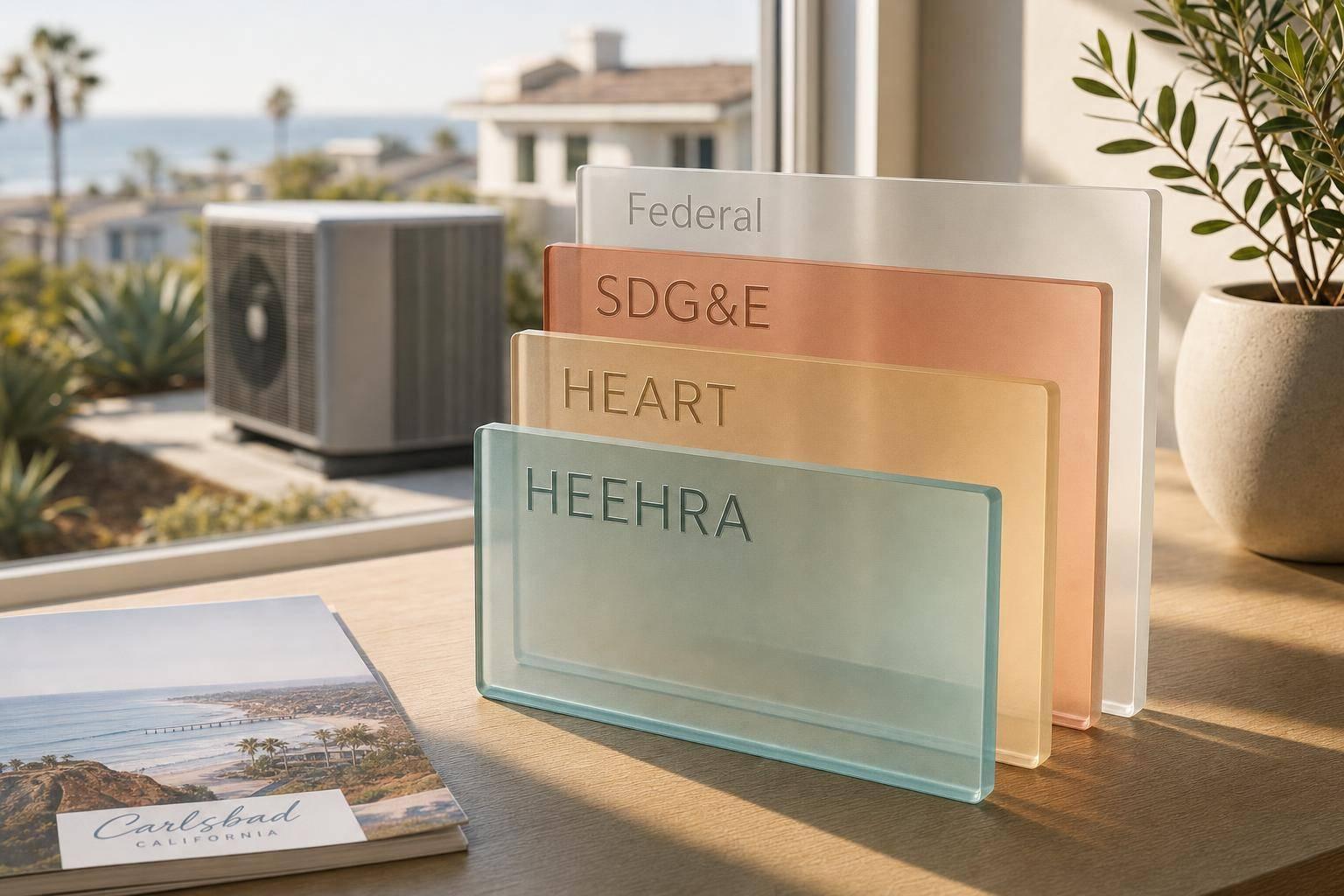
The 2026 Carlsbad HVAC Rebate Stack: HEEHRA + HEART + Federal + SDG&E
If you’re planning an HVAC upgrade in Carlsbad in 2026, the short answer is this: federal HVAC tax credits are gone, but state and utility rebates may still cut your bill if you set up the project the right way.
I’d keep these points in mind first:
- HEEHRA may still cover heat pumps and panel work for households at or below 150% AMI, but many single-family funds were already reserved or waitlisted by early 2026.
- You must get HEEHRA approval before install starts. If work begins first, that rebate can be lost.
- Federal Section 25C and 25D do not apply to 2026 installs.
- SDG&E rebates are still active, but only for listed products and program-approved paths.
- Carlsbad addresses do not always qualify for local HEART-style programs, so ZIP code and service area checks matter.
- Each invoice line should go to one program only. You can stack by item, not by charging the same cost twice.
This means your rebate plan is less about finding one big program and more about assigning the right rebate to the right part of the job - HVAC equipment, panel work, duct sealing, thermostat, or water heater.
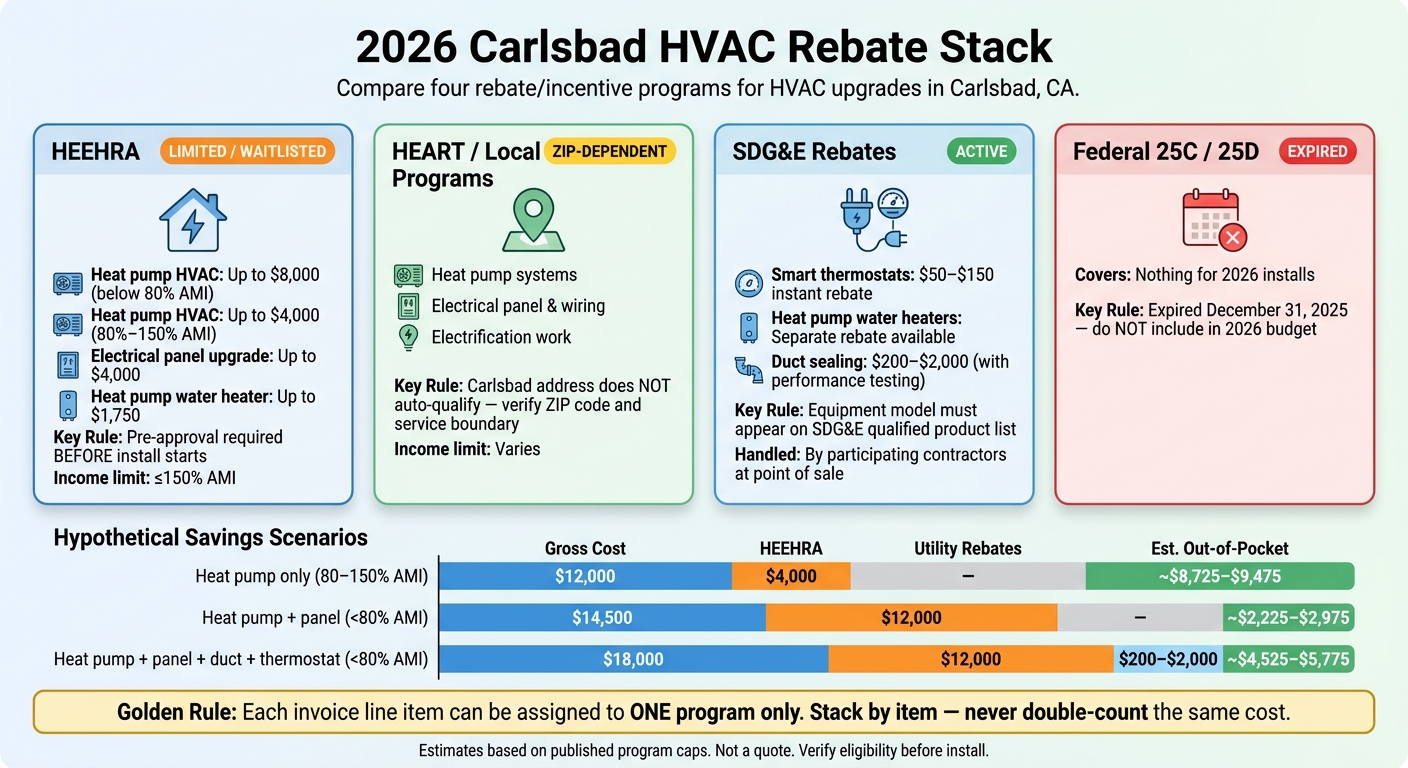
2026 Carlsbad HVAC Rebate Stack: Programs, Amounts & Eligibility
Home Energy Tax Credits 2026: What Expired and What's Left
sbb-itb-a7630c3
Quick comparison
| Program | 2026 status | What it may cover | Main rule |
|---|---|---|---|
| HEEHRA | Limited in many areas | Heat pumps, some panel work, some electrification items | Income limits and pre-approval before install |
| HEART / local | Area-dependent | Wiring, panel, and some electrification work | Carlsbad eligibility must be checked by ZIP/service area |
| SDG&E | Active | Select equipment like smart thermostats and some electrification items | Product must be on the approved list |
| Federal 25C / 25D | Expired for 2026 installs | None | Ended after 12/31/2025 |
If I were reviewing a contractor quote, I’d first check income tier, HEEHRA status, product eligibility, and itemized invoice lines before signing anything.
2026 program rules: HEEHRA, HEART, federal pathways, and SDG&E
HEEHRA coverage for heat pumps and panel work
HEEHRA can still be a big piece of the puzzle in 2026, but the rules are tight.
Households below 80% AMI can get up to $8,000 for heat pumps. Households at 80%–150% AMI can get up to $4,000. If the project also needs electrification-related panel work, households under 150% AMI may get up to $4,000 more for that upgrade.
There are two catches that matter right away. First, the equipment must meet 15+ SEER2 and 9+ HSPF2. Second, installation can't begin until the reservation approval is in place.
That timing piece matters a lot in 2026. California's single-family HEEHRA funds were largely reserved or waitlisted by early 2026. So before you build a budget around HEEHRA, check the California state energy office portal or DSIRE.org to see whether funds are open in your area.
HEART and local electrification rebates in the San Diego area
If HEEHRA doesn't cover the whole job, HEART and other local electrification rebates may help fill the gap.
In some San Diego-area jurisdictions, these programs can help pay for heat pump, panel, and wiring work. That's useful when the main HVAC equipment is covered but the electrical side of the job still adds up.
Carlsbad is where people often trip up. An address there does not automatically qualify. You need to confirm the ZIP code and the service boundary before applying.
What SDG&E and federal HVAC tax credits cover in 2026
SDG&E rebates are more of a smaller add-on than a full project fund, but they can still cut the final balance.
SDG&E offers instant rebates on qualifying residential equipment, and those rebates are usually handled by participating contractors at the point of sale. In 2026, eligible items include qualifying smart thermostats and heat pump water heaters. The model number has to appear on SDG&E's qualified product list. A similar product won't count automatically.
Federal HVAC tax credits are no longer part of the 2026 picture. Those credits ended after 2025, which means 2026 savings come from state and utility rebates, not federal HVAC tax credits.
The table below shows which program fits each upgrade.
| Program | 2026 Status | Primary Benefit | Key Restriction |
|---|---|---|---|
| HEEHRA | Limited / waitlisted in many areas | Up to $8,000 for heat pumps; $4,000 for panels | Income-limited (≤150% AMI); pre-approval required |
| Federal 25C | Expired Dec. 31, 2025 | None for 2026 installs | Not available for new 2026 work |
| SDG&E | Active | Instant equipment rebates | Must match qualified product list |
| HEART/Local | ZIP-dependent | Electrification, wiring, and panel work | Carlsbad service area must be verified |
Which HVAC upgrades can be stacked in Carlsbad
Heat pump HVAC, water heaters, and electrical panel upgrades
Once you know the program rules, the job becomes pretty simple: match each upgrade to the right rebate or incentive.
For heat pump HVAC, HEEHRA is the main program to look at. It offers up to $8,000 for households below 80% AMI, or up to $4,000 for households at 80%–150% AMI. If panel work is part of the job, HEEHRA can add up to $4,000 more for that upgrade. The big rule here is simple: each cost can go to one program only.
Heat pump water heaters fall into their own HEEHRA category. That item can qualify for up to $1,750, and it may also be eligible for separate SDG&E or TECH Clean California rebates. That sounds great, but you still need to keep each expense tied to just one funding source.
Duct sealing, insulation, and smart thermostat add-ons
Some smaller add-ons can still move the numbers in your favor.
Duct sealing may qualify for utility or state rebates, often up to $2,000 when it's paired with testing or part of a broader efficiency scope. SDG&E also offers $50 to $150 instant rebates on qualifying smart thermostats. Insulation can qualify under utility or state programs too, but don't pencil that in too early. Check current eligibility on DSIRE.org before you build your budget.
Program-to-upgrade comparison table
| Upgrade | HEEHRA | TECH Clean California / Local Programs | SDG&E | Federal 25C |
|---|---|---|---|---|
| Heat pump HVAC | Up to $8,000 below 80% AMI, or up to $4,000 at 80%–150% AMI; point-of-sale; pre-approval required | Varies | Separate utility/state rebate or instant discount for qualifying models | Not available in 2026 |
| Heat pump water heater | Up to $1,750; income ≤150% AMI; point-of-sale | Varies | Separate utility/state rebate may be available | Not available in 2026 |
| Electrical panel upgrade | Up to $4,000; income ≤150% AMI; point-of-sale | Varies | Not typically covered | Not available in 2026 |
| Duct sealing | Varies by state program | Varies | $200–$2,000; often requires performance testing | Not available in 2026 |
| Insulation | Varies by state program | Varies | Utility/state rebates; confirm eligibility first | Not available in 2026 |
| Smart thermostat | Usually separate | Varies | $50–$150 instant rebate on qualified models | Not available in 2026 |
After you assign one funding source to each line item, the next move is to estimate your net project cost. Then you can map those items into a compliant stack and figure out your out-of-pocket total.
How to build a compliant rebate stack and estimate out-of-pocket cost
Step 1: Confirm income tier, property location, and equipment eligibility
Start by matching each cost in your project to one program only using the line-item map above. That matters more than it may seem. If the same expense gets tied to two rebate sources, the whole plan can get messy fast.
First, confirm your AMI tier and HEEHRA reservation status before installation begins. Second, make sure your contractor is handling the SDG&E instant-rebate paperwork the right way. Third, check that the proposed equipment meets the required efficiency ratings and that the contractor has completed a proper load calculation.
If your home is near the coast, plan for coastal-rated components. Those parts can add $450 to $950 to the project cost, and that amount usually stays on the homeowner side of the bill.
California's HEEHRA single-family funds were heavily reserved by early 2026, so it's smart to confirm current availability and lock in a reservation through the state portal before any equipment is ordered or installed.
Once you've confirmed eligibility, the next move is simple: break the proposal into separate invoice lines before work starts.
Step 2: Assign each invoice line to one primary funding source
After you've cleared the eligibility checks, ask your contractor for a fully itemized proposal. You want each part of the job listed on its own line: equipment, labor, electrical work, duct sealing, permits, and any coastal upgrades.
Then assign each eligible line item to one primary program.
- Start with HEEHRA for the heat pump and panel work.
- Use SDG&E or TECH Clean California rebates for other eligible items, such as duct sealing or a smart thermostat. Those rebates often land in the $200 to $2,000 range.
- If panel work is included, that line can use HEEHRA's separate panel upgrade category, up to $4,000.
Some costs usually stay with the homeowner. In Carlsbad, permit fees often run $275 to $525, and HOA-required screening or condenser relocation is generally not covered by these programs.
Hypothetical savings examples and cost comparison table
Each example below assigns only one program to each invoice line. Use them as a rough way to estimate net cost before you sign.
| Scenario | Example Gross Project Cost | HEEHRA Rebate | Utility Rebates | Homeowner-Paid Costs | Estimated Out-of-Pocket |
|---|---|---|---|---|---|
| Heat pump HVAC only (80–150% AMI) | $12,000 | $4,000 | Not included | $725–$1,475 for permit + coastal-rated components | $8,725–$9,475 |
| Heat pump + panel upgrade (<80% AMI) | $14,500 | $12,000 total | Not included | $725–$1,475 | $2,225–$2,975 |
| Heat pump + panel + duct sealing + thermostat (<80% AMI) | $18,000 | $12,000 total | $200–$2,000 on duct sealing/thermostat lines | $725–$1,475 | $4,525–$5,775 |
These are rough estimates based on cited caps and local cost ranges, not quotes. SDG&E and TECH Clean California rebates may also lower the first two examples, but the rule stays the same: each invoice line should point to only one primary funding source, so the same cost isn't counted twice.
Final checklist before starting an HVAC rebate project in Carlsbad
Key takeaways for homeowners reviewing 2026 upgrade options
Use this final check before you sign anything. The goal is simple: keep your rebate stack valid from start to finish.
- HEEHRA status: Before you schedule installation, confirm HEEHRA funds are open and that your reservation approval is in place. Work cannot start before approval.
- Federal credits: Do not build your 2026 budget around Section 25C or 25D. Both expired on Dec. 31, 2025.
- Utility rebates and HOA: Treat SDG&E rebates as your default incentive. If you live in an HOA community, get HOA approval first so you don't run into delays or last-minute plan changes.
- Required documents: Gather your paperwork before any order is placed. If you don't have a Manual J and an AHRI certificate, stop the project until both are in hand.
FAQs
How do I know if my Carlsbad address qualifies for HEART or local rebates?
Check whether your household income is at or below 150% of San Diego County Area Median Income (AMI). HEART is for households that meet income rules.
Program rollout and availability can change by area. So before you move ahead, confirm your status through the DSIRE database or your utility provider’s official rebate portal for the latest local program details.
What documents should I have before my HVAC installation starts?
Before installation, make sure your contractor has the required City of Carlsbad mechanical permit. That part matters. It helps keep the job on track and in line with local rules.
If you plan to apply for rebates or incentives, ask your contractor for an AHRI certificate. This document shows that the system meets the needed efficiency standards.
For income-qualified programs, have your income documents ready ahead of time. Common examples include:
- a W-2
- a 1099
- a recent tax return
Your contractor should take care of the main SDG&E and state program paperwork.
Which costs are usually not covered by HVAC rebates in 2026?
In 2026, HVAC rebates usually don’t pay for the full install labor bill, city-required mechanical permit fees, or needed electrical panel and circuit upgrades.
Homeowners also usually cover ductwork repairs or full duct replacement out of pocket. The same goes for coastal-rated equipment upgrades, like corrosion-resistant coatings or marine-grade fasteners.