
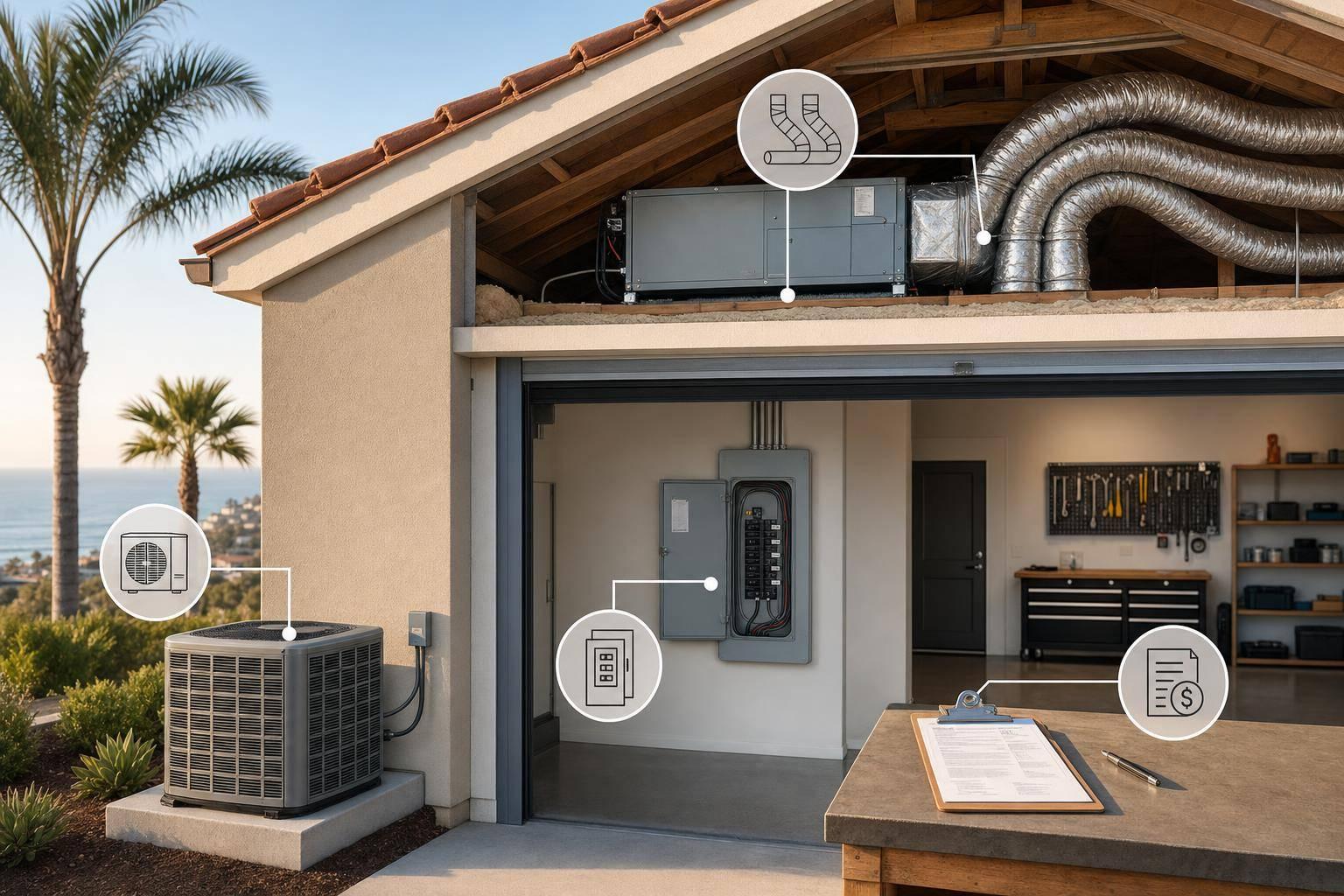
What HVAC Installation Actually Costs in Carlsbad and San Diego (2026)
If I’m comparing HVAC quotes in Carlsbad or San Diego in 2026, I’d expect most installed jobs to land around $9,000 to $18,000, with some projects falling below or above that based on system type, ducts, electrical work, and coastal conditions.
Here’s the short version: one quote may include permits, HERS testing, duct fixes, and coastal-rated parts, while another may leave those out. That’s why two bids for what looks like the same job can be thousands of dollars apart.
If I wanted to judge a quote fast, I’d focus on these points:
- System type matters: central AC, furnace, heat pump, and mini-split installs all fall into different ranges.
- Coastal homes often cost more: salt air can add about 10% to 15% for treated coils and cabinets.
- Duct and electrical work swing the total: duct replacement can add $5,000 to $12,000, and panel upgrades can add $1,500 to $5,000 or more.
- Permits and HERS testing are often required: these usually add $500 to $1,500.
- Heat pumps may cost less out of pocket after incentives: stacked rebates and the $2,000 federal 25C tax credit can cut the final amount by $3,000 to $8,500 in some cases.
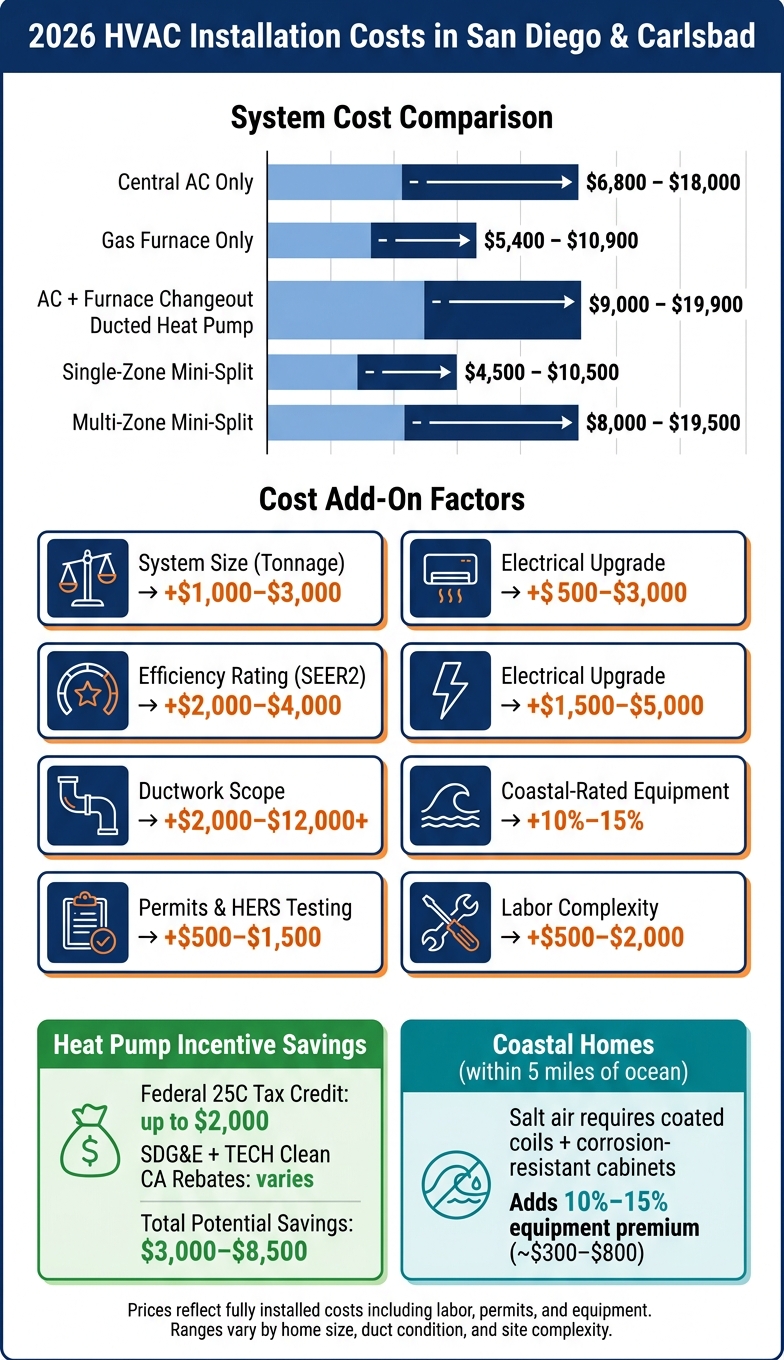
2026 HVAC Installation Cost Comparison: San Diego & Carlsbad
The Real Cost of Replacing an HVAC System in 2026 (No BS)
sbb-itb-a7630c3
Quick comparison
| System | Typical installed range | What usually moves it up |
|---|---|---|
| Central AC only | $6,800–$18,000 | Coastal rating, larger tonnage, higher SEER2 |
| Gas furnace only | $5,400–$10,900 | Larger homes, variable-speed models |
| AC + furnace changeout | $9,000–$19,900 | Duct repairs, electrical work, efficiency upgrades |
| Ducted heat pump | $9,000–$22,000 | Panel upgrade, premium inverter equipment |
| Single-zone mini-split | $4,500–$10,500 | Coastal parts, long line runs |
| Multi-zone mini-split | $8,000–$19,500 | More indoor units, harder routing |
When I read this piece, I’d use it as a quote-checking guide: compare installed scope, not just equipment, and make sure the estimate lists the model numbers, efficiency ratings, permits, HERS, ductwork, electrical items, and warranty details before signing.
2026 HVAC installation cost ranges by system type
These ranges reflect installed pricing, not equipment-only quotes.
Central AC, furnace, and full HVAC changeout costs
In San Diego, installed pricing usually covers the outdoor unit, indoor unit or air handler, evaporator coil, refrigerant line sets, condensate drain, thermostat, labor, old equipment removal, and permits.
A central AC-only replacement usually runs $6,500 to $12,000 inland and $9,500 to $18,000 near the coast. The coastal jump comes from corrosion-resistant coils and treated cabinets, which add about a 10% to 15% equipment premium.
A gas furnace-only install usually falls between $5,400 and $10,900. The top end tends to cover larger homes or high-efficiency variable-speed models.
A full HVAC changeout usually lands between $9,000 and $19,900. In most cases, two things move that number the most: ductwork condition and available electrical capacity.
Heat pump and ductless mini-split installation costs
Heat pumps make sense in San Diego because the climate stays mild, and winter temperatures rarely push them outside their efficient heating range.
A ducted heat pump usually costs $9,000 to $22,000 before rebates. When you stack the Federal 25C tax credit, capped at $2,000, with SDG&E and TECH Clean California rebates, the net cost can drop by $3,000 to $8,500. In some cases, that makes a heat pump cheaper out of pocket than a standard AC-only replacement.
Ductless mini-splits start lower because a single-zone setup needs just one indoor unit and a short refrigerant line run. Installed costs usually range from $2,500 to $10,500. Multi-zone systems that cover two to four rooms usually fall between $8,000 and $19,500.
Coastal-rated units cost more in both cases because of treated coils and corrosion-resistant cabinets.
Low, typical, and high-end cost scenarios
The same system can come in at very different numbers depending on what the installer has to change. This table shows what tends to push a quote into low, typical, or high-end territory.
| Project Type | Low-End | Typical | High-End |
|---|---|---|---|
| Central AC + Gas Furnace | 14.3 SEER2, single-stage, existing ducts and electrical intact | 16 SEER2, two-stage, minor duct sealing, standard permits | 18+ SEER2, variable-speed, coastal-rated, new ductwork |
| Ducted Heat Pump | Entry-level efficiency, standard air handler, no panel upgrade | 16–18 SEER2, variable-speed, standard rebates applied | 20+ SEER2, premium brand, panel upgrade required |
| Ductless Mini-Split | Single-zone, wall-mount, short refrigerant line run | 2–3 zones, coastal-rated, standard electrical work | 4+ zones, ceiling cassettes, complex line routing, high-efficiency |
A few upgrades explain most of that spread. Low-end pricing usually assumes the ducts are in good shape, the electrical service can handle the new system, and no coastal-rated equipment is needed.
High-end quotes often include one or more of these add-ons:
- Full duct replacement: $5,000 to $12,000
- Electrical panel upgrade: $2,500 to $5,000
- Coastal-rated equipment
Those are also the items that often separate a fair quote from one that feels padded.
What drives HVAC quotes up or down
Most quote gaps come from three things: scope, system size, and site conditions. That’s why two homes that seem alike can end up with very different installed totals. For example, a bid that lists only the condenser and air handler can leave out $1,200 to $2,400 in installed costs. After that, the biggest levers are system size and efficiency.
System size, efficiency ratings, and equipment type
System size (tonnage) is the first big variable. A 2,200 sq. ft. home in coastal La Jolla will often need only 2 to 2.5 tons of cooling. The same home in inland Poway may need 3 to 3.5 tons because inland design temperatures run 12°F to 16°F hotter.
That jump matters. More tonnage usually means a larger outdoor unit, a larger coil, and a higher installed cost. In many cases, that size change alone adds about $1,000 to $3,000. This is why it helps to ask for a Manual J load calculation. Sizing by square footage alone can overshoot the home’s needs and push the quote up.
Efficiency tier is the next major factor. Moving from a base 14.3 SEER2 system to a premium 20–22 SEER2 inverter model adds about $2,000 to $4,000 in equipment cost. On paper, higher efficiency sounds like the obvious pick. In San Diego’s mild climate, though, that added amount may take a long time to earn back through lower utility bills.
Once the equipment is sized, the home itself starts driving the quote.
Ductwork, electrical upgrades, permits, and labor complexity
In many pre-2000 homes, ducts are either too small, too leaky, or both. California Title 24 requires duct leakage testing, and if leakage is above 15%, the ducts must be sealed or replaced. That can move the quote fast. Partial duct changes often cost $2,000 to $5,000, while full replacement can add $5,000 to $12,000+.
Electrical service is another common issue. Older panels under 125 amps often can’t support a modern heat pump without an upgrade. If you’re moving to all-electric, plan for about $1,500 to $5,000 for a panel upgrade.
Then there are the required project items that many homeowners don’t think about at first. Permits and mandatory HERS testing for refrigerant charge verification and duct leakage usually add $500 to $1,500. And if the job site is tough to work in - tight attic access, a rooftop unit, or a hillside layout - you may see another $500 to $2,000 added for labor difficulty.
Coastal conditions, home layout, and other San Diego-specific factors
Carlsbad brings one more factor into the mix: salt air. Homes within five miles of the ocean usually need coated coils and corrosion-resistant cabinets. That tends to add a 10% to 15% equipment premium, or about $300 to $800.
There’s a simple reason for that. Standard condensers wear out faster near the coast, so coastal installs often land near the top end of local price ranges. On top of that, labor rates and permitting in Carlsbad and San Diego tend to keep installed costs above inland markets.
| Cost Factor | Typical Cost Impact | What to Look for on the Estimate |
|---|---|---|
| System Size (Tonnage) | +$1,000–$3,000 | Manual J calculation, correct tonnage |
| Efficiency (SEER2) | +$2,000–$4,000 | SEER2 rating, inverter vs. single-stage |
| Ductwork Scope | +$2,000–$12,000+ | Duct leakage test results, R-8 insulated ductwork |
| Electrical Upgrade | +$1,500–$5,000 | Panel amperage, dedicated 240V circuit |
| Coastal-rated equipment | +10%–15% | Coated coils, corrosion-resistant cabinet |
| Permits & HERS Testing | +$500–$1,500 | City permit fees, HERS rater testing |
| Labor Complexity | +$500–$2,000 | Attic/rooftop access surcharge, crane fees |
What a complete HVAC installation estimate should include
Once you know what pushes cost up or down, the next step is simple: make sure every quote covers the same job. A low number on page one doesn't mean much if key work is missing. That's why it helps to compare bids line by line.
Equipment, labor, permits, and warranty details to check
Every estimate should spell out the exact make, model number, tonnage, and efficiency ratings for each unit. For cooling, that means SEER2. For heating, it means HSPF2. If those details aren't listed, you can't tell whether two contractors are quoting the same system or if one is pricing a unit that's a full efficiency tier lower.
The estimate should also separate equipment from labor and materials. That includes labor, startup and commissioning, and parts used during the install. A standard one-day swap often runs $1,500 to $2,400 in labor alone. When labor is rolled into one lump sum, it's much harder to check.
Materials matter too. These should appear as their own line items:
- Refrigerant line set
- Electrical disconnect
- Secondary float switch
- Condenser pad
- Thermostat
Permits and HERS verification should also be listed on their own, along with who is responsible for pulling them. If the home is near the coast, the quote should note coastal-rated components with coated coils.
Warranty terms need the same level of detail. The estimate should list the manufacturer's parts warranty and the installer's labor warranty separately. Manufacturer parts coverage is often 10 years with registration, while labor warranties usually run 1 to 5 years. If the quote just says "warranty included", that doesn't tell you much.
Common add-ons and change-order charges to watch for
Some costs don't show up until the crew gets into the job. Still, the better contractors call them out in writing before work starts.
Duct sealing or minor repairs usually run $500 to $2,500, while full duct replacement can run $5,000 to $12,000+. Electrical work may add $400 to $2,500 for basic circuit or breaker work. If a heat pump needs a full panel upgrade, that can run $2,500 to $5,000+.
Access can change the math too. If the install involves a rooftop unit, a tight attic, or a hillside home, crane or access charges should be written into the estimate upfront, not added later out of nowhere.
For 2026 installs, check that the estimate names the refrigerant type and states that the system is built for newer A2L refrigerants such as R-454B or R-32, along with the right tools and line sets.
Add-ons like a smart thermostat, UV-C light, or MERV 13 filter are usually cheaper to include from the start. If you wait and add them later, you may end up paying for a second labor visit. A smart thermostat typically adds $220 to $360 installed when bundled upfront.
A checklist for comparing San Diego HVAC quotes side by side
Use this table to compare each quote against the same standard before you sign.
| Category | What to Confirm on the Estimate |
|---|---|
| Equipment | Brand, model #, SEER2/HSPF2, tonnage, coastal-rated parts |
| Sizing Method | Manual J load calculation |
| Labor & Disposal | Old system removal, EPA refrigerant recovery, disposal fees, startup and commissioning |
| Materials | New refrigerant line set, electrical disconnect, secondary float switch, condenser pad/platform, thermostat |
| Ductwork | Duct leakage test and scope of sealing or replacement |
| Electrical | Dedicated circuit, breaker sizing, panel upgrade if required |
| Permits & HERS | Itemized city or county permit fee, HERS verification, CF-2R/CF-3R registration |
| Warranty | Manufacturer parts and installer labor warranty stated separately |
| Incentives | SDG&E and TECH Clean California rebate handling, Federal 25C tax credit eligibility noted |
| Change-Order Triggers | Crane access, asbestos abatement, HOA architectural review if needed |
A quote that leaves out several of these items isn't a full estimate. Once the scope is clear, you can look at which system makes sense for the home and budget.
How to pick the right system and budget for your home
Once the quotes are lined up the same way, the next step is pretty simple: figure out whether you need a basic replacement or a bigger update.
When a standard replacement is enough and when a full upgrade makes sense
A straight swap makes sense when your ducts leak less than 15% and your electrical panel can handle the new load.
A full upgrade is the better call when the ducts are old, too small, or in rough shape. The same goes if you're moving from gas heat to a heat pump. That kind of switch often leads to a panel upgrade, which can add $2,500 to $5,800.
A HERS test can help confirm whether duct repairs are needed before you lock in the budget. That way, you're working from a cleaner number before choosing the final system type.
If your main goal is keeping upfront spending down, lower-efficiency equipment may fit better. If you'd rather spend more now and cut utility costs over time, higher-efficiency equipment or a heat pump usually makes more sense.
Matching system type to common San Diego home situations
After that, match the system to the home's location and what the house already has.
| Home Situation | Best System Match | Key Tradeoff |
|---|---|---|
| Coastal home (within 5 miles of ocean) | Heat pump with coastal-rated coils | 10–15% higher upfront cost; standard units wear out faster near the coast |
| Inland home (Escondido, El Cajon, Poway) | High-efficiency AC + gas furnace, or ducted heat pump | Heat pumps are a strong fit for San Diego's mild climate and may require an electrical panel upgrade |
| Older home without existing ducts | Ductless multi-zone mini-split | Avoids costly duct installation; eliminates up to 30% duct energy loss |
| Home with solar PV | All-electric ducted heat pump | Maximizes return on solar under NEM 3.0; heating can run on self-generated power |
| Budget-focused, good existing ducts | Central AC + gas furnace swap | Best for budget-conscious upfront spending; no federal heat pump tax credits |
For many San Diego homes, the all-in cost of a heat pump after rebates can come in lower than the all-in cost of an equivalent-efficiency AC-only system.
Key takeaways for comparing HVAC estimates in 2026
The installed price is the number that counts, not the equipment-only sticker.
If a quote leaves out permits, HERS testing, or ductwork scope, it isn't showing the full job. And if you compare that kind of stripped-down bid against one that includes everything, you're likely to make the wrong call. Go line by line and use the comparison checklist from the previous section.
Local labor and permitting keep installed prices above national averages. In San Diego, most installs land around $9,000 to $18,000, depending on the system type, job scope, and any coastal-related needs.
FAQs
How do I know if an HVAC quote is missing key items?
A good HVAC quote should be itemized, not shown as one lump-sum number.
That means it should spell out:
- labor
- equipment make and model
- SEER2 and HSPF2 ratings
- permit costs
- electrical work costs
Why does that matter? Because a bundled quote can blur what you're paying for. And that makes it harder to compare one contractor with another.
It should also include an ACCA Manual J load calculation, California Title 24 compliance, and HERS rater testing. If those items are missing, the quote is incomplete.
Bundled pricing can also hide costs and make the total look lower than it is by $1,200 to $2,400.
Will a heat pump cost less than AC and furnace after rebates?
Yes. A heat pump can often cost less than a standard AC and furnace setup once you factor in available incentives.
Heat pumps usually come with a higher upfront cost. But federal tax credits like the 25C Energy Efficient Home Improvement Credit and local SDG&E rebates can cut what you pay out of pocket by a lot. Standard central AC and furnace systems usually don’t qualify for those same heat pump incentives, so the gap in cost often gets much smaller - and in some cases, a heat pump may end up costing less.
Do I need new ductwork or an electrical panel upgrade?
It depends on your home’s age and condition.
In Carlsbad and across San Diego, many homes built before 2000 have ductwork that’s too small, leaky, or both. That can create a problem when you install a newer system. In some cases, the ducts need sealing. In others, they need changes or a full replacement so the system can work the way it should and meet Title 24.
Older homes can run into another issue: the electrical panel may not have enough capacity for a new HVAC unit or heat pump. During your estimate, a licensed contractor should check both the ductwork and the panel to make sure the installation is safe, code-compliant, and energy-efficient.